
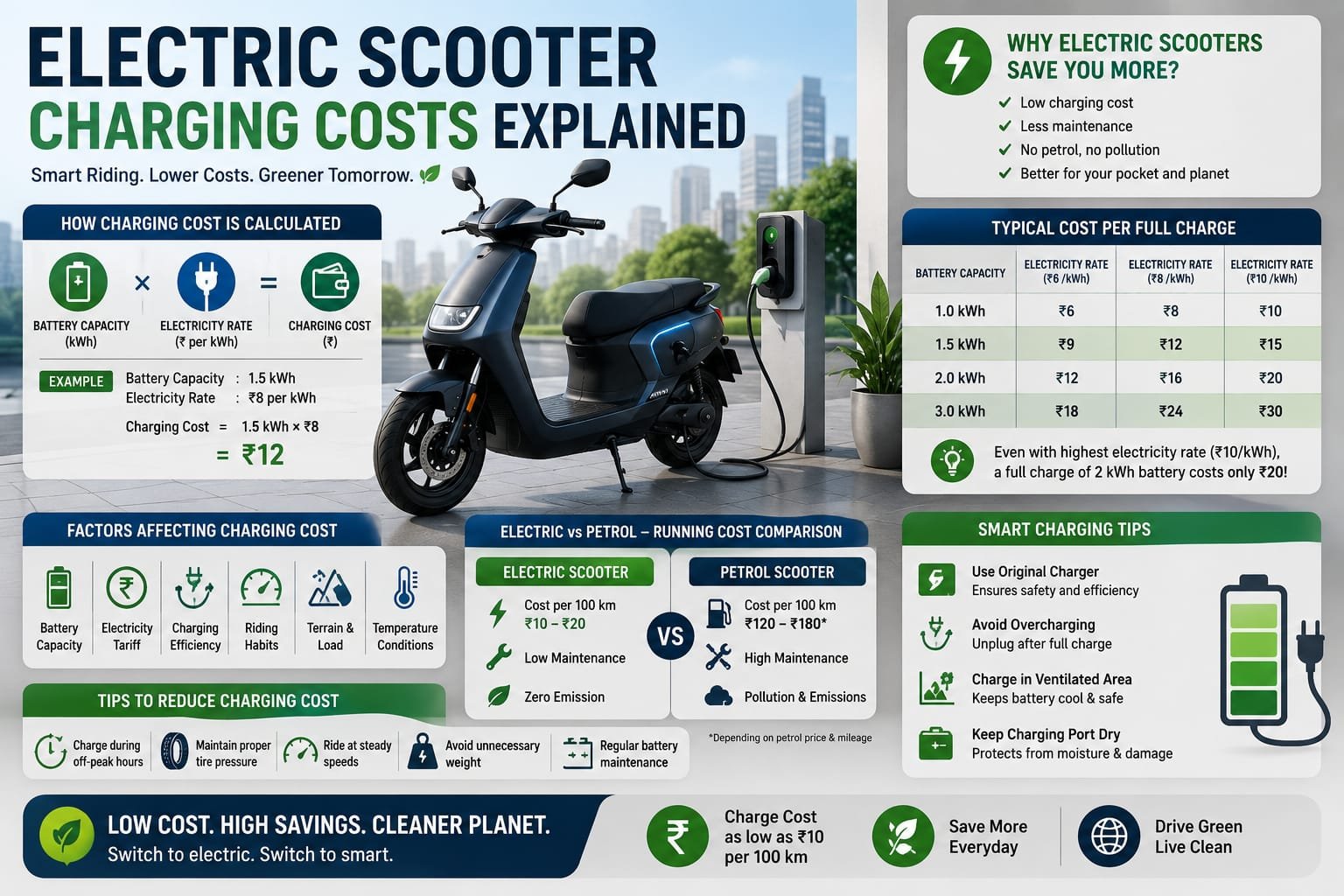
Electric Scooter Charging Costs Explained
Electric Scooter Charging Costs are one of the biggest reasons why electric scooters have become a popular choice for cost-conscious and environmentally conscious riders. Electric scooters have become one of the most affordable and eco-friendly transportation options available today. Whether you’re commuting to work, attending college, or running daily errands, an electric scooter can significantly reduce your transportation expenses compared to petrol-powered vehicles. With low electricity consumption and minimal running costs, electric scooters offer an economical solution for everyday travel.
One of the biggest reasons people choose electric scooters is their incredibly low charging cost. While petrol prices continue to fluctuate, electricity remains a relatively stable and economical energy source. Many new riders, however, often wonder: How much does it actually cost to charge an electric scooter?
The answer depends on several factors, including battery capacity, local electricity rates, charging habits, and how frequently you ride. Fortunately, even with these variables, charging an electric scooter is usually far less expensive than refueling a conventional scooter.
In this guide, we’ll explain how charging costs are calculated, what influences electricity consumption, and how you can reduce your charging expenses while keeping your scooter’s battery healthy.
Why Electric Scooter Charging Costs Matter?
Understanding charging costs helps you:
- Estimate monthly transportation expenses
- Compare electric and petrol scooters
- Plan your commuting budget
- Maximize battery efficiency
- Reduce electricity consumption
- Calculate long-term ownership costs
Knowing these costs allows you to make informed purchasing and usage decisions.
How Electric Scooter Charging Works
Electric scooters store energy in rechargeable lithium-ion batteries. When connected to a charger, electricity from your home or workplace replenishes the battery.
The charger converts AC (Alternating Current) from the electrical outlet into DC (Direct Current) suitable for the battery. A Battery Management System (BMS) monitors charging to help maintain safety and battery health.
Understanding Battery Capacity
Battery capacity is measured in kilowatt-hours (kWh) or watt-hours (Wh).
Examples:
- 500 Wh = 0.5 kWh
- 1000 Wh = 1.0 kWh
- 1500 Wh = 1.5 kWh
- 2000 Wh = 2.0 kWh
Generally, larger batteries store more energy and provide longer range but require more electricity to recharge fully.
How Charging Cost Is Calculated
The basic formula is:
Charging Cost = Battery Capacity (kWh) × Electricity Rate (per kWh)
For example:
- Battery Capacity: 2 kWh
- Electricity Rate: ₹8 per kWh
Charging Cost = 2 × ₹8 = ₹16
Actual costs vary depending on your local electricity tariff and charging efficiency.
Factors That Affect Charging Costs
Several variables influence the amount you pay to charge your electric scooter.
1. Battery Size
Larger batteries require more electricity to recharge.
2. Electricity Tariffs
Electricity prices differ by:
- Country
- State
- Utility provider
- Residential or commercial plans
- Time-of-use pricing
3. Charging Efficiency
Some energy is lost as heat during charging, so the electricity drawn from the outlet may be slightly higher than the battery’s rated capacity.
4. Riding Frequency
Daily commuters naturally spend more on charging than occasional riders.
5. Riding Style
Aggressive acceleration and higher speeds consume more energy, increasing how often you need to recharge.
Comparing Electric Scooter and Petrol Scooter Running Costs
One of the biggest advantages of electric scooters is lower operating costs.
Electric Scooter
- Electricity instead of petrol
- Fewer moving parts
- Lower maintenance
- No engine oil changes
- Lower routine servicing costs
Petrol Scooter
- Regular fuel purchases
- Engine maintenance
- Oil changes
- Spark plug replacement
- Higher servicing expenses
Over time, the difference in operating costs can be significant.
Charging at Home
Most electric scooter owners charge at home because it is convenient and often the most economical option.
Benefits include:
- Easy overnight charging
- Consistent electricity rates
- No waiting at fuel stations
- Reduced travel costs
- Convenient daily routine
A dedicated charging area with proper ventilation is recommended.
Workplace Charging
Some employers provide charging facilities for employees.
Advantages include:
- Reduced personal electricity costs
- Convenient charging during work hours
- Extended daily range
Availability depends on workplace infrastructure and policies.
Public Charging Stations
As electric mobility expands, public charging stations are becoming more common.
Benefits include:
- Convenient for long-distance travel
- Useful when away from home
- Supports growing EV infrastructure
Public charging fees vary depending on the provider and charging speed.
Charging Time and Electricity Consumption
Charging time depends on:
- Battery size
- Charger power
- Battery condition
- Ambient temperature
Larger batteries typically require more time and electricity to recharge fully.
How to Reduce Charging Costs
You can minimize electricity expenses by adopting smart charging habits.
Charge Before the Battery Is Completely Empty
Avoid frequent deep discharges whenever possible. Keeping the battery within the manufacturer’s recommended operating range can improve long-term performance.
Use the Original Charger
Manufacturer-approved chargers are designed to optimize charging efficiency and battery safety.
Maintain Correct Tire Pressure
Properly inflated tires reduce rolling resistance, helping improve energy efficiency.
Ride Smoothly
Gentle acceleration and maintaining steady speeds reduce energy consumption.
Avoid Carrying Unnecessary Weight
Additional weight requires more power, reducing overall efficiency.
Keep the Scooter Well Maintained
Clean tires, properly adjusted brakes, and a healthy drivetrain (where applicable) all contribute to better efficiency.
Does Fast Charging Cost More?
Some premium electric scooters support faster charging.
While fast charging reduces waiting time, it may:
- Generate additional heat
- Affect long-term battery health if used excessively
- Cost more when using certain public charging networks
Occasional fast charging is generally acceptable if recommended by the manufacturer.
Battery Health and Charging Costs
A healthy battery maintains efficient charging and consistent range.
To protect battery health:
- Avoid prolonged exposure to extreme temperatures.
- Charge in a dry, ventilated location.
- Keep charging ports clean.
- Store the battery at the recommended charge level if it will be unused for long periods.
- Follow the manufacturer’s charging guidelines.
A well-maintained battery performs more efficiently over its lifespan.
Environmental Benefits of Low Charging Costs
Lower charging costs are not the only advantage of electric scooters.
Charging with electricity can also help:
- Reduce greenhouse gas emissions
- Lower air pollution
- Decrease dependence on fossil fuels
- Support renewable energy adoption
- Encourage sustainable transportation
When powered by renewable electricity, electric scooters become even more environmentally friendly.
Common Charging Mistakes
Avoid these habits:
- Using damaged charging cables
- Charging in wet conditions
- Blocking ventilation around the charger
- Ignoring battery warning messages
- Leaving charging equipment exposed to rain
- Using non-certified chargers
Following safe charging practices helps protect both the battery and the rider.
Frequently Asked Questions
Is charging an electric scooter cheaper than buying petrol?
Yes. In most cases, charging an electric scooter costs significantly less than fueling a comparable petrol scooter, making it more economical for daily transportation.
Can I charge my scooter overnight?
Many manufacturers allow overnight charging when using the original charger and built-in battery management system. Always follow the recommendations in your owner’s manual.
Does charging every day damage the battery?
No. Regular charging is generally safe for lithium-ion batteries when performed according to the manufacturer’s instructions.
Can I use any charger?
No. Always use the charger approved by the scooter manufacturer to ensure safe and efficient charging.
Does weather affect charging?
Yes. Very high or very low temperatures can affect charging efficiency and battery performance. Charge the scooter in moderate environmental conditions whenever possible.
Tips for Long-Term Savings
To reduce your overall ownership costs:
- Keep tires properly inflated.
- Ride efficiently.
- Maintain the battery.
- Follow the recommended service schedule.
- Store the scooter correctly.
- Charge using approved equipment.
- Plan routes to maximize efficiency.
Small habits can result in meaningful savings over the life of the scooter.
The Future of Affordable Electric Mobility
Advances in battery technology, smart charging systems, renewable energy integration, and improved energy efficiency are making electric scooters even more affordable to own and operate.
Future innovations are expected to include:
- Faster and more efficient charging
- Longer-lasting batteries
- Smart energy management
- Vehicle-to-grid integration
- Expanded charging infrastructure
- Lower overall operating costs
These developments will continue to strengthen electric scooters as one of the most cost-effective transportation options available.
Conclusion
Electric scooters offer one of the lowest day-to-day operating costs of any personal vehicle, and charging them is generally far more affordable than purchasing petrol. Although the exact cost depends on battery size, local electricity prices, charging efficiency, and riding habits, most owners find that electricity expenses remain minimal compared to fuel costs.
By understanding how charging costs are calculated and following smart charging practices, you can maximize battery life, reduce electricity consumption, and enjoy years of reliable, economical transportation. Whether you’re commuting every day or riding occasionally, an electric scooter provides an efficient and sustainable way to travel while keeping your transportation budget under control.