
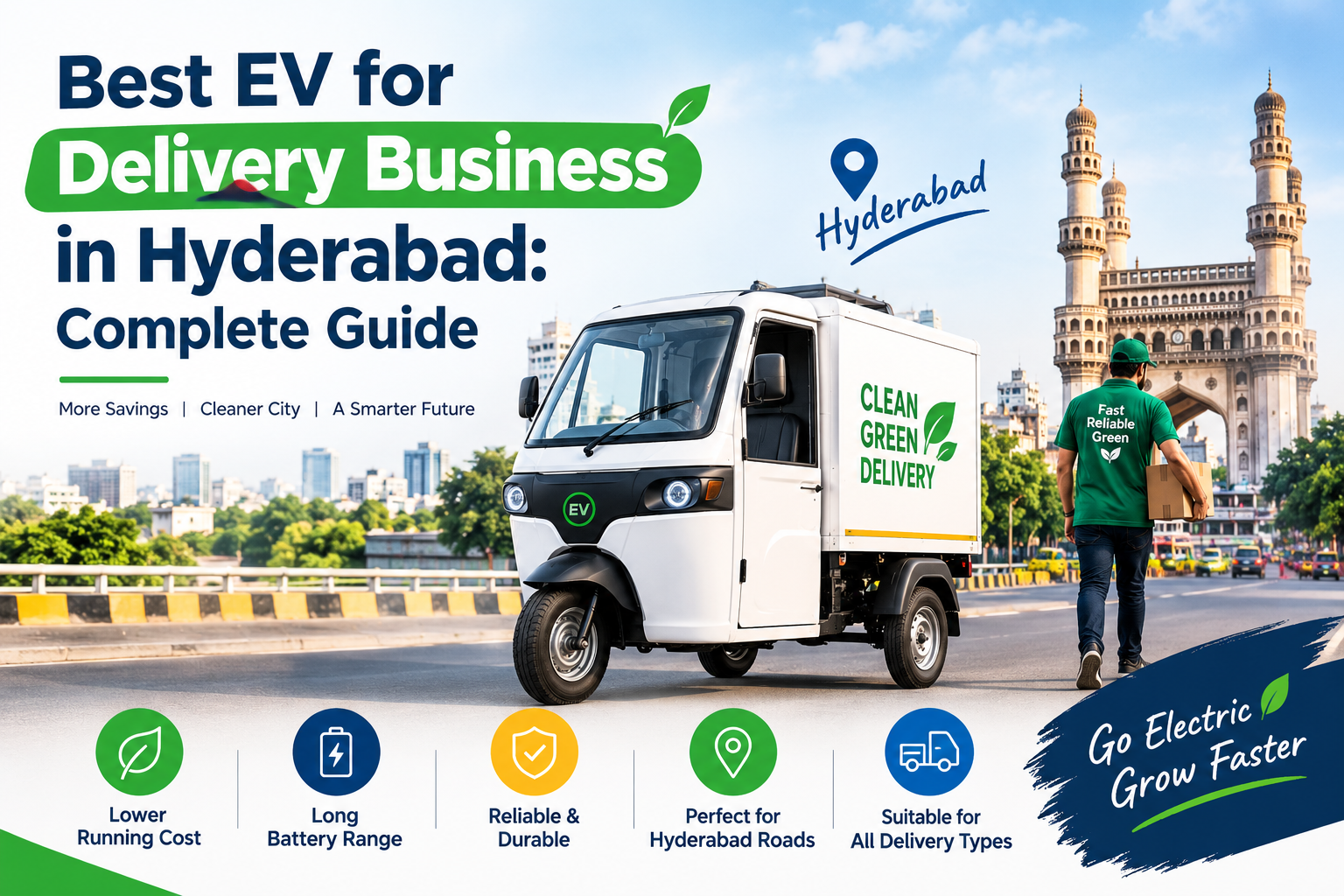
Hyderabad has become a fast-growing market for e-commerce, food delivery, grocery delivery, pharmacy distribution, and local logistics. As fuel prices and operating expenses continue to affect delivery businesses, electric vehicles (EVs) are becoming an attractive option for businesses looking to reduce running costs and improve delivery efficiency.
If you are searching for the best EV for delivery business in Hyderabad, it is important to look beyond the purchase price. Range, payload capacity, charging time, battery technology, maintenance costs, comfort, reliability, and after-sales support all play an important role in choosing the right electric vehicle.
In this guide, we explore what businesses should consider when selecting an electric delivery vehicle in Hyderabad and how EVs can support profitable last-mile delivery operations.
Why Choose an EV for Delivery Business in Hyderabad?
Delivery vehicles often travel long distances every day, particularly in busy urban areas. Traditional petrol and diesel vehicles can have significant running and maintenance expenses.
Electric vehicles offer several potential advantages for commercial delivery operations:
- Lower running costs
- Reduced dependence on petrol and diesel
- Lower routine maintenance requirements
- Quiet operation
- Zero tailpipe emissions
- Convenient city transportation
- Suitable for frequent stop-and-go delivery routes
- Potentially lower cost per kilometre
For businesses making multiple deliveries every day, reducing operating costs can have a significant impact on overall profitability.
What Is the Best EV for Delivery Business?
The best electric vehicle depends on the type of delivery operation. A small business delivering food or parcels within the city may need a compact electric three-wheeler, while businesses transporting heavier goods may require a higher-payload electric commercial vehicle.
When selecting an EV for delivery business, consider the following factors.
1. Battery Range
Range is one of the most important specifications for a commercial electric vehicle.
A delivery vehicle should ideally provide enough usable range to complete a typical working shift without frequent charging. However, actual range can vary depending on:
- Payload
- Traffic conditions
- Driving style
- Road conditions
- Weather
- Vehicle load
- Use of lights and accessories
For Hyderabad’s urban delivery routes, select a vehicle with sufficient practical range for your daily operating distance rather than relying only on the manufacturer’s maximum claimed range.
2. Payload Capacity
Delivery businesses need to transport different types of goods. Before purchasing an EV, determine how much weight your vehicle normally carries.
For example, grocery delivery may require moderate cargo capacity, while construction materials, commercial goods, or wholesale products may require a higher payload.
Choosing an EV with the right load capacity helps prevent overloading and supports safer, more efficient operations.
3. Charging Time
Charging time directly affects vehicle utilization.
A delivery vehicle that takes too long to recharge can reduce the number of trips completed during the day. Businesses should therefore consider the battery capacity, charging technology, charging infrastructure, and availability of charging points.
If your business operates multiple EVs, establishing charging facilities at your warehouse, office, or delivery hub can make fleet management easier.
4. Total Cost of Ownership
The purchase price is only one part of the cost of operating an electric delivery vehicle.
Businesses should calculate the total cost of ownership, including:
- Vehicle purchase price
- Electricity costs
- Charging equipment
- Insurance
- Maintenance
- Tyres
- Battery-related expenses
- Financing costs
- Registration and applicable taxes
- Resale value
An EV with a slightly higher initial price may still be more economical if it delivers lower operating costs over its working life.
Electric Three-Wheelers for Delivery Businesses
Electric three-wheelers are becoming an important option for last-mile logistics. Their compact size makes them suitable for navigating crowded urban streets and narrow roads.
An electric three-wheeler in Hyderabad can be used for:
- Grocery delivery
- Food distribution
- E-commerce deliveries
- Courier services
- Pharmacy deliveries
- Parcel transportation
- Retail distribution
- Small business logistics
- Local commercial transportation
Their relatively compact dimensions can also make parking and loading easier in busy commercial areas.
Electric Loader Vehicles for Commercial Delivery
Businesses transporting heavier goods may consider electric loader vehicles.
Electric loaders can be useful for:
- Wholesale distribution
- Vegetable and fruit transportation
- Hardware supplies
- Retail goods
- Small manufacturing businesses
- Warehouse-to-store transportation
- Local construction materials
- E-commerce logistics
When choosing an electric loader, businesses should compare payload capacity, range, battery specifications, cargo-bed dimensions, ground clearance, warranty, and service support.
Best EV Features for Hyderabad Delivery Routes
Hyderabad has a combination of busy city roads, residential areas, commercial zones, highways, and developing outskirts. A commercial EV should therefore be capable of handling varied operating conditions.
Important features include:
Good Ground Clearance
Adequate ground clearance can help when driving over speed breakers, uneven roads, and rougher sections of urban routes.
Strong Payload Performance
The motor and drivetrain should be capable of handling the vehicle’s rated payload efficiently.
Durable Build Quality
Commercial vehicles generally experience more frequent use than personal vehicles, so durability is important.
Comfortable Driver Area
Delivery drivers may spend many hours on the road. Comfortable seating, easy controls, good visibility, and practical ergonomics can improve daily usability.
Reliable Braking System
A dependable braking system is essential for frequent urban stop-and-go driving.
Convenient Charging
Businesses should have access to convenient charging at their operating location or along their regular delivery routes.
EV vs Petrol or Diesel Delivery Vehicle
One of the biggest advantages of EVs for delivery businesses is the potential reduction in operating costs.
| Factor | Electric Vehicle | Petrol/Diesel Vehicle |
|---|---|---|
| Energy cost | Generally lower | Generally higher |
| Routine maintenance | Typically lower | Typically higher |
| Tailpipe emissions | Zero | Higher |
| Noise | Low | Higher |
| Urban stop-and-go use | Well suited | Fuel intensive |
| Charging/refuelling | Requires charging planning | Faster refuelling |
| Initial purchase | Depends on model | Depends on model |
The actual savings depend on electricity rates, fuel prices, daily kilometres, payload, vehicle efficiency, financing, and maintenance.
How to Choose the Best EV for Your Delivery Business
Before purchasing an EV, answer these questions:
How many kilometres does the vehicle travel every day?
Calculate your average daily route and include additional kilometres for unexpected deliveries.
How much weight do you transport?
Choose a vehicle whose rated payload matches your business requirements.
Where will you charge the vehicle?
Plan charging infrastructure before adding an EV to your fleet.
How many deliveries do you make per day?
Higher delivery volumes require careful consideration of range and charging time.
What is your budget?
Consider both upfront cost and long-term operating expenses.
Is service support available nearby?
A strong service network can reduce downtime and help maintain fleet productivity.
EV Delivery Business Opportunities in Hyderabad
Hyderabad offers opportunities for electric commercial vehicles because of the growth of online shopping, food delivery, organized retail, local commerce, and last-mile logistics.
Businesses can use EVs for both B2B and B2C deliveries.
For example, a retailer can use an electric vehicle for local customer deliveries, while a distribution company can use electric loaders to transport products between warehouses and shops.
Small entrepreneurs can also explore delivery services for local businesses, supermarkets, restaurants, pharmacies, and e-commerce sellers.
Tips to Reduce EV Delivery Costs
To maximize the benefits of an electric delivery vehicle:
- Plan efficient delivery routes.
- Avoid unnecessary idling and driving.
- Maintain recommended tyre pressure.
- Avoid overloading the vehicle.
- Follow recommended charging practices.
- Monitor electricity consumption.
- Schedule preventive maintenance.
- Track daily kilometres and delivery costs.
- Use fleet management tools when appropriate.
- Train drivers in efficient EV driving.
Efficient route planning can be particularly important for businesses operating multiple vehicles.
Conclusion
Choosing the best EV for delivery business in Hyderabad depends on your delivery requirements, daily distance, payload, budget, charging facilities, and expected operating conditions.
For lightweight last-mile deliveries, an electric three-wheeler can provide a practical solution. For heavier commercial transportation, an electric loader may be more appropriate. Businesses should compare range, payload, charging time, battery technology, warranty, service support, and total cost of ownership before making a purchase.
As businesses continue to look for more economical and sustainable transportation solutions, electric commercial vehicles in Hyderabad can play an increasingly important role in last-mile delivery and local logistics.
The right EV is not simply the vehicle with the highest range or lowest price—it is the one that matches your daily business requirements while helping you operate efficiently and profitably.