
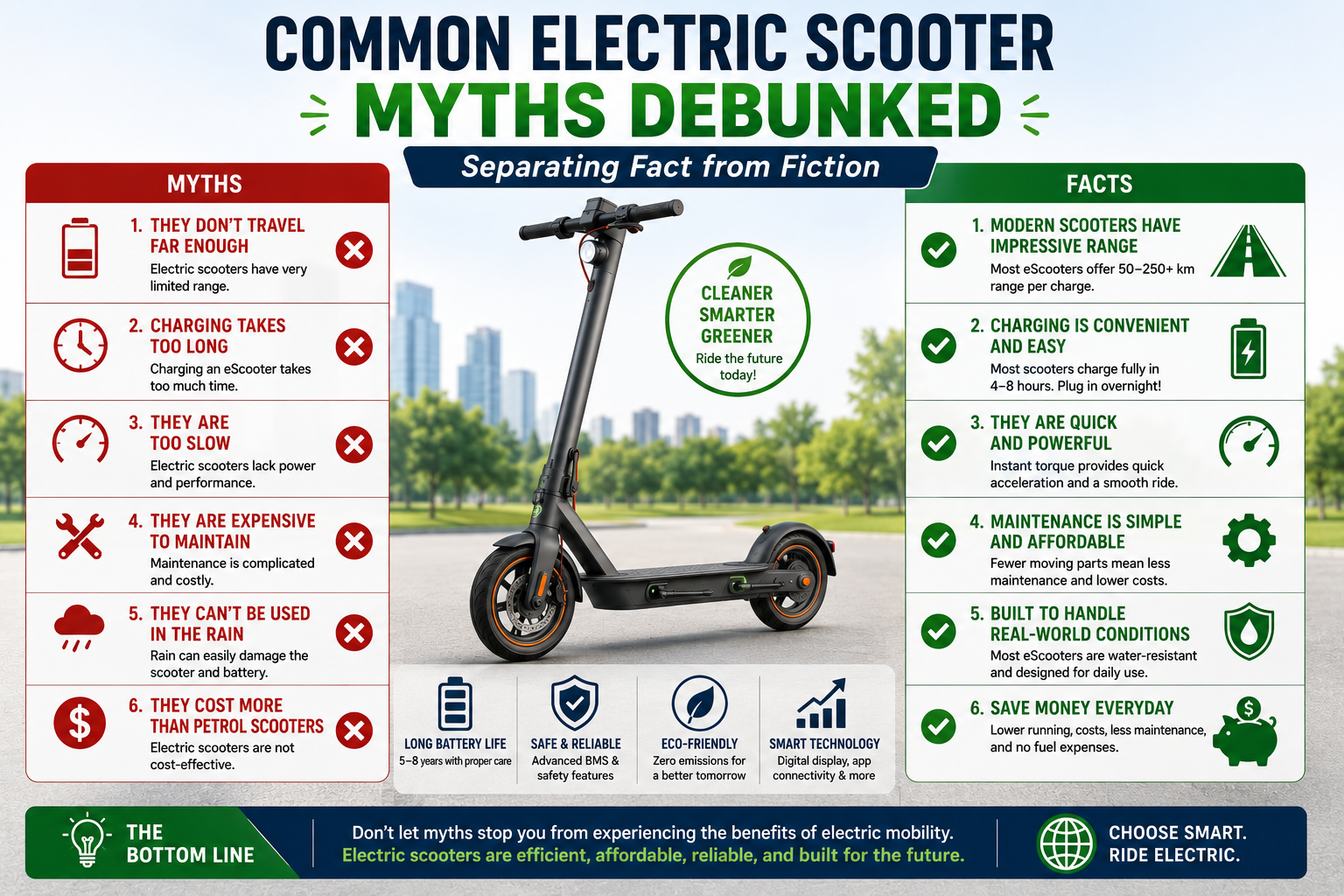
Common Electric Scooter Myths Debunked: Separating Fact from Fiction
Electric Scooter Myths often create confusion among people who are considering switching to electric mobility. Many believe that electric scooters have limited range, require expensive maintenance, or are not suitable for daily commuting. However, advancements in battery technology, motor performance, and charging infrastructure have made modern electric scooters more reliable and efficient than ever before. In this guide, we’ll separate fact from fiction by debunking the most common electric scooter myths and helping you make an informed buying decision.
Electric scooters have become one of the fastest-growing transportation options around the world. With rising fuel prices, increasing environmental awareness, and rapid advancements in battery technology, more people are switching from petrol-powered vehicles to electric mobility.
Despite their growing popularity, electric scooters are still surrounded by myths and misconceptions. Some people believe they are too expensive to own, while others think they don’t have enough range or that their batteries need frequent replacement. These misconceptions often discourage potential buyers from making an informed decision.
The reality is that modern electric scooters are more reliable, efficient, and practical than ever before. Improvements in lithium-ion battery technology, charging infrastructure, and smart features have transformed them into a dependable solution for daily commuting.
In this comprehensive guide, we’ll debunk the most common electric scooter myths and reveal the facts every rider should know before buying or using an electric scooter.
Why So Many Electric Scooter Myths Exist
Electric scooters are still relatively new compared to traditional petrol scooters. As with any emerging technology, outdated information and assumptions often spread faster than facts.
Many myths come from:
- Older battery technology
- Early electric vehicle models
- Lack of awareness
- Misleading online information
- Comparing old models with modern eScooters
Understanding the facts helps buyers make smarter decisions.
Myth 1: Electric Scooters Don’t Travel Far Enough
One of the biggest misconceptions is that electric scooters have very limited range.
The Reality
Modern electric scooters can typically travel anywhere from 50 km to over 250 km on a single charge, depending on the model, battery capacity, riding style, and terrain.
For most urban commuters, this range is more than enough for daily travel.
If your daily commute is 25–40 km, many electric scooters can easily handle it without requiring an additional charge during the day.
Myth 2: Charging Takes Too Long
Many people assume charging an electric scooter is inconvenient.
The Reality
Most electric scooters can be fully charged within 4 to 8 hours, making overnight charging simple and convenient.
Some premium models also support fast charging, reducing charging time to 2–4 hours.
For many riders, charging at home overnight eliminates the need for frequent visits to fuel stations.
Myth 3: Electric Scooters Are Too Slow
Another common myth is that electric scooters lack performance.
The Reality
Today’s electric scooters deliver instant torque, providing smooth and quick acceleration.
Many premium models offer performance comparable to or even better than many traditional city scooters.
For urban commuting, electric scooters provide responsive acceleration that’s ideal for stop-and-go traffic.
Myth 4: Battery Replacement Is Needed Every Year
Battery replacement is often considered a major concern.
The Reality
Modern lithium-ion batteries typically last between 5 and 8 years, depending on usage and maintenance.
Most batteries are designed to withstand hundreds or even thousands of charging cycles.
Proper charging habits can further extend battery life.
Myth 5: Electric Scooters Cost More Than Petrol Scooters
The purchase price of some electric scooters may appear higher.
The Reality
While the initial investment can be greater, electric scooters usually offer:
- Lower charging costs
- Reduced maintenance
- No engine oil changes
- Fewer mechanical repairs
- Lower operating expenses
Over time, many owners save money compared to riding a petrol scooter.
Myth 6: Electric Scooters Are Difficult to Maintain
Some people believe electric vehicles require specialized maintenance.
The Reality
Electric scooters actually have fewer moving parts than petrol scooters.
There are:
- No engine oil changes
- No spark plugs
- No clutch
- No gearbox
- No exhaust system
Routine maintenance mainly involves tires, brakes, suspension, and battery inspections.
Myth 7: Electric Scooters Aren’t Safe
Safety concerns often arise because electric scooters use high-voltage batteries.
The Reality
Modern scooters include multiple safety systems, including:
- Battery Management Systems (BMS)
- Overcharge protection
- Temperature monitoring
- Short-circuit protection
- Regenerative braking (on some models)
Many scooters also feature advanced braking systems, LED lighting, and smart safety alerts.
Myth 8: Rain Will Damage an Electric Scooter
Many buyers worry about riding in wet weather.
The Reality
Most electric scooters are designed with water-resistant components and can handle light to moderate rain, depending on their IP (Ingress Protection) rating.
However, riders should avoid:
- Deep water
- Flooded roads
- High-pressure water washing
Always check the manufacturer’s recommended water-resistance rating.
Myth 9: Electric Scooters Lose Battery Quickly in Cold Weather
Cold weather does affect batteries—but not in the way many people think.
The Reality
Low temperatures can temporarily reduce battery efficiency and available range, but the battery usually returns to normal performance when temperatures become moderate again.
Proper storage and charging practices help maintain battery health.
Myth 10: Electric Scooters Can’t Climb Hills
Many people believe electric scooters struggle on steep roads.
The Reality
Hill-climbing ability depends on:
- Motor power
- Battery output
- Rider weight
- Road gradient
Many modern scooters are specifically designed to handle moderate and even steep inclines with ease.
Myth 11: Electric Scooters Have No Resale Value
Some buyers worry that electric scooters depreciate too quickly.
The Reality
As demand for electric vehicles continues to grow, well-maintained scooters with healthy batteries can retain good resale value.
Factors affecting resale include:
- Battery condition
- Service history
- Brand reputation
- Overall maintenance
Myth 12: Electric Scooters Are Only for Short Trips
Some assume electric scooters are useful only for short city rides.
The Reality
While they excel in urban commuting, many long-range models comfortably support:
- Daily office travel
- Delivery services
- Weekend rides
- Intercity commuting (where practical)
Choosing the right range for your needs is the key.
Myth 13: Charging Every Day Damages the Battery
Daily charging is often misunderstood.
The Reality
Lithium-ion batteries are designed for regular charging.
In fact, allowing the battery to drain completely before charging is generally less beneficial than maintaining regular charging habits.
Following the manufacturer’s recommendations helps maximize battery life.
Myth 14: Electric Scooters Are Complicated to Use
Some first-time riders worry that electric scooters are difficult to operate.
The Reality
Most electric scooters are extremely beginner-friendly.
They typically feature:
- Twist throttle
- Automatic transmission
- Digital dashboard
- Simple controls
- Smooth acceleration
New riders usually adapt quickly.
Myth 15: Electric Scooters Are Just a Trend
Some people believe electric mobility is temporary.
The Reality
Governments, manufacturers, and consumers worldwide are investing heavily in electric transportation.
Advances in battery technology, charging infrastructure, and sustainability goals indicate that electric mobility is becoming a long-term solution rather than a passing trend.
Electric Scooter Myths Every First-Time Buyer Should Know
Before purchasing your first electric scooter, it’s important to understand the facts instead of believing common misconceptions. Learning the truth behind Electric Scooter Myths will help you make a confident buying decision and choose the right EV for your daily needs.
Keep these points in mind:
- Don’t judge by outdated information – Modern electric scooters offer better technology, performance, and reliability than earlier models.
- Compare battery range – Choose a scooter with a range that comfortably covers your daily commute.
- Check charging time – Many newer models support faster and more convenient charging.
- Review the battery warranty – A good warranty reflects the manufacturer’s confidence in battery quality.
- Evaluate safety features – Look for disc brakes, LED lighting, CBS/ABS, and quality tires.
- Consider maintenance costs – Electric scooters generally require less maintenance than petrol scooters.
- Take a test ride – Experience the scooter’s comfort, handling, and performance before making your purchase.
- Research after-sales support – Ensure service centers and spare parts are easily available.
- Calculate long-term savings – Consider fuel savings, lower servicing costs, and reduced maintenance expenses.
- Buy from a trusted EV dealer – Choose a reliable showroom that provides expert guidance, warranty support, and after-sales service.
Frequently Asked Questions about Electric Scooter Myths
Are electric scooters reliable?
Yes. Modern electric scooters are designed for dependable daily use and require less maintenance than traditional petrol scooters.
How long does the battery last?
Most lithium-ion batteries last between 5 and 8 years with proper care.
Is charging expensive?
Charging an electric scooter generally costs much less than refueling a petrol scooter, making it an economical choice for daily commuting.
Can I ride in the rain?
Most electric scooters can handle light rain if they have an appropriate water-resistance rating. Avoid deep water and always follow the manufacturer’s guidelines.
Are electric scooters suitable for beginners?
Absolutely. Their automatic operation, smooth acceleration, and simple controls make them easy to learn and ride.
Conclusion
Electric scooters have evolved into a practical, efficient, and eco-friendly mode of transportation. Many of the myths surrounding them are based on outdated information or misconceptions from early electric vehicle technology. Today’s models offer impressive range, reliable batteries, lower maintenance costs, advanced safety features, and excellent performance for everyday commuting.
By understanding the facts, you can confidently evaluate whether an electric scooter fits your lifestyle and transportation needs. Instead of relying on myths, focus on real-world performance, manufacturer specifications, and your daily riding requirements. As technology continues to improve, electric scooters will play an even greater role in shaping the future of sustainable urban mobility.