
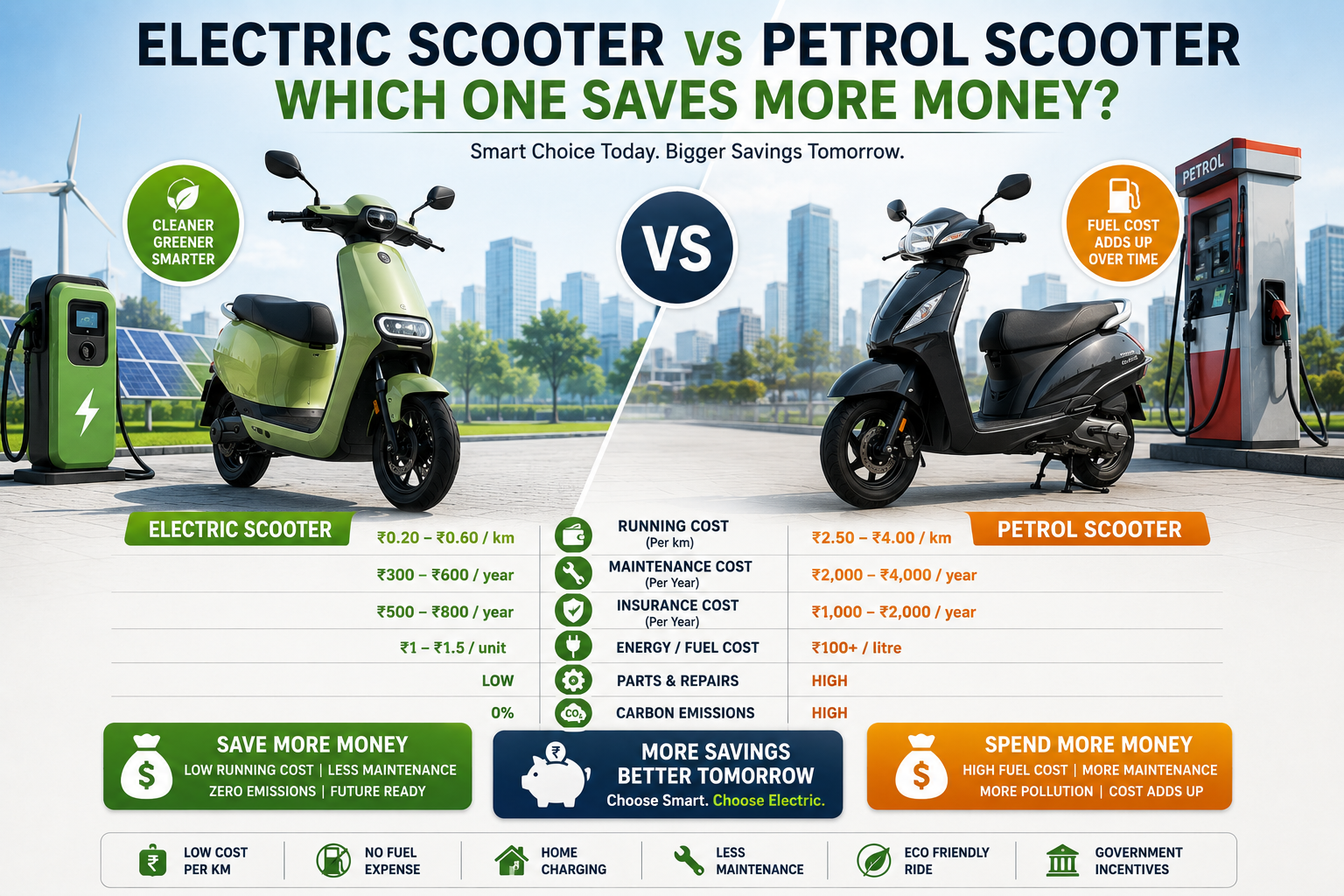
Electric Scooter vs Petrol Scooter: Which One Saves More Money?
With rising fuel prices, increasing environmental awareness, and rapid advancements in electric vehicle technology, many people are asking the same question: Should I buy an electric scooter or a petrol scooter?
While both options have their advantages, the biggest deciding factor for most buyers is the total cost of ownership. It’s not just about the purchase price—fuel, maintenance, servicing, insurance, and long-term running costs all play a major role.
Electric scooters have become more affordable, offer excellent performance for city commuting, and are significantly cheaper to operate. Petrol scooters, on the other hand, are familiar, widely available, and quick to refuel. But when you compare the costs over several years, the results can be surprising.
In this guide, we’ll compare electric scooters and petrol scooters across every major cost factor to help you decide which one saves more money in 2026.
Understanding the Total Cost of Ownership
Many buyers focus only on the showroom price. However, the real expense of owning a scooter includes:
- Purchase price
- Fuel or electricity costs
- Maintenance
- Repairs
- Insurance
- Registration
- Battery replacement (for electric scooters)
- Resale value
Looking at the complete ownership cost gives a much clearer picture of which option provides better value.
1. Purchase Price
Traditionally, petrol scooters have been less expensive to purchase than electric scooters. However, the price gap has narrowed considerably thanks to improvements in manufacturing and government incentives in many regions.
Petrol Scooter
- Lower upfront price
- Wide variety of models
- Readily available across dealerships
Electric Scooter
- Slightly higher initial investment (depending on the model)
- Competitive pricing in 2026
- Advanced technology and smart features often included
Although an electric scooter may cost more initially, the savings during ownership often offset the higher purchase price.
2. Running Costs
This is where electric scooters clearly stand out.
A petrol scooter requires regular refueling, and fuel prices fluctuate frequently. An electric scooter only needs electricity, which is much cheaper.
Typical Cost Per Kilometer
Electric Scooter
- Approximately ₹0.20–₹0.60 per km
Petrol Scooter
- Approximately ₹2.50–₹4.00 per km
If you travel 40 km daily, the annual savings on fuel alone can be substantial.
Over five years, these savings can amount to tens of thousands of rupees.
3. Maintenance Costs
Petrol engines contain hundreds of moving components.
Regular servicing usually includes:
- Engine oil changes
- Oil filters
- Spark plugs
- Air filters
- Clutch adjustments
- Exhaust maintenance
Electric scooters eliminate many of these parts.
Routine maintenance generally includes:
- Brake checks
- Tire replacement
- Suspension inspection
- Battery diagnostics
Because electric motors are simpler, they require less maintenance and experience fewer mechanical failures.
4. Charging vs Fueling Convenience
Petrol Scooter
Advantages:
- Refuels in a few minutes
- Fuel stations widely available
Disadvantages:
- Fuel price increases
- Regular trips to fuel stations
- Waiting during busy hours
Electric Scooter
Advantages:
- Charge at home overnight
- No fuel station visits
- Lower energy costs
- Convenient daily charging
Many modern electric scooters also support fast charging, reducing charging time significantly.
5. Battery Costs
One concern buyers often have is battery replacement.
Modern lithium-ion batteries are designed to last several years.
Typical battery lifespan:
- 5–8 years
- Thousands of charging cycles
Although replacing a battery represents a future expense, the savings on fuel and maintenance during those years often outweigh this cost.
Manufacturers also continue improving battery durability while reducing replacement costs.
6. Insurance Costs
Insurance premiums vary depending on the scooter model, location, and coverage.
Electric scooters may qualify for:
- Lower insurance premiums
- Government incentives
- Reduced registration fees in some regions
Always compare policies before purchasing.
7. Repairs
Electric scooters generally require fewer repairs because they have:
- No engine
- No gearbox
- No clutch
- No exhaust system
With fewer mechanical parts, the likelihood of major repairs decreases.
Petrol scooters may require more frequent servicing and replacement of engine-related components over time.
8. Environmental Costs
While environmental impact doesn’t appear directly on your monthly budget, it plays an important role.
Electric scooters produce:
- Zero tailpipe emissions
- Lower noise pollution
- Reduced dependence on fossil fuels
Choosing electric mobility contributes to cleaner air and healthier cities.
9. Daily Commuting Experience
Electric scooters provide:
- Instant acceleration
- Quiet riding
- Smooth performance
- Minimal vibration
Petrol scooters offer:
- Longer range
- Quick refueling
- Familiar riding experience
For most city commuters traveling moderate distances, electric scooters provide an efficient and enjoyable riding experience.
10. Long-Term Savings
Let’s compare ownership over five years for a rider covering approximately 12,000 kilometers annually.
Petrol Scooter
Expenses include:
- Fuel
- Regular servicing
- Engine oil
- Filters
- Mechanical repairs
- Higher operating costs
Electric Scooter
Expenses include:
- Electricity
- Minimal maintenance
- Brake servicing
- Tire replacement
- Occasional software updates (depending on the model)
Despite the higher purchase price, many electric scooter owners recover the additional cost through lower operating expenses within a few years.
Electric Scooter vs Petrol Scooter Comparison
| Feature | Electric Scooter | Petrol Scooter |
|---|---|---|
| Running Cost | Very Low | High |
| Fuel Cost | Electricity | Petrol |
| Maintenance | Low | Moderate to High |
| Noise | Quiet | Louder |
| Tailpipe Emissions | Zero | Present |
| Home Charging | Yes | No |
| Engine Oil | Not Required | Required |
| Smart Features | Common | Limited |
| Daily City Commute | Excellent | Good |
| Long-Term Savings | High | Lower |
Who Should Buy an Electric Scooter?
An electric scooter is ideal if you:
- Commute daily within the city
- Want to reduce fuel expenses
- Prefer lower maintenance
- Care about environmental sustainability
- Have access to home charging
- Value smart technology features
Who Should Buy a Petrol Scooter?
A petrol scooter may be suitable if you:
- Frequently travel very long distances
- Need rapid refueling during extended trips
- Live in an area with limited charging infrastructure
- Prefer traditional engine performance
Tips Before Buying
Before making your decision, consider:
Daily Travel Distance
Choose a scooter with sufficient range for your daily commute.
Charging Availability
Ensure convenient charging access at home or work.
Warranty
Look for comprehensive warranty coverage, especially for the battery.
Service Network
Choose a manufacturer with authorized service centers nearby.
Total Ownership Cost
Think beyond the purchase price and calculate fuel, maintenance, and repair costs over several years.
Frequently Asked Questions
Which is cheaper to run: an electric scooter or a petrol scooter?
Electric scooters generally cost much less to operate because electricity is significantly cheaper than petrol, and maintenance requirements are lower.
Do electric scooters require less maintenance?
Yes. They have fewer moving parts and do not require engine oil changes, spark plug replacements, or exhaust maintenance.
Is charging cheaper than buying petrol?
In most cases, yes. Charging an electric scooter typically costs only a small fraction of the equivalent petrol expense.
Are electric scooters worth buying in 2026?
For most urban commuters, electric scooters offer excellent value due to lower running costs, advanced features, and reduced environmental impact.
Which scooter has better resale value?
Resale value depends on the brand, condition, battery health, and market demand. As electric mobility continues to grow, demand for well-maintained electric scooters is also increasing.
Conclusion
When comparing the overall cost of ownership, electric scooters generally save more money than petrol scooters, especially for daily city commuters. Although the upfront purchase price may be slightly higher, the savings on fuel, maintenance, and servicing often make electric scooters the more economical choice over time.
Petrol scooters remain a practical option for riders who frequently cover long distances or need quick refueling in areas with limited charging infrastructure. However, for most urban users, electric scooters provide a winning combination of affordability, convenience, smart technology, and environmental responsibility.
As battery technology continues to improve and charging infrastructure expands, the financial advantages of electric scooters are likely to become even stronger. If your goal is to reduce transportation costs while enjoying a quieter, cleaner, and more efficient ride, an electric scooter is a smart investment for 2026 and beyond.