
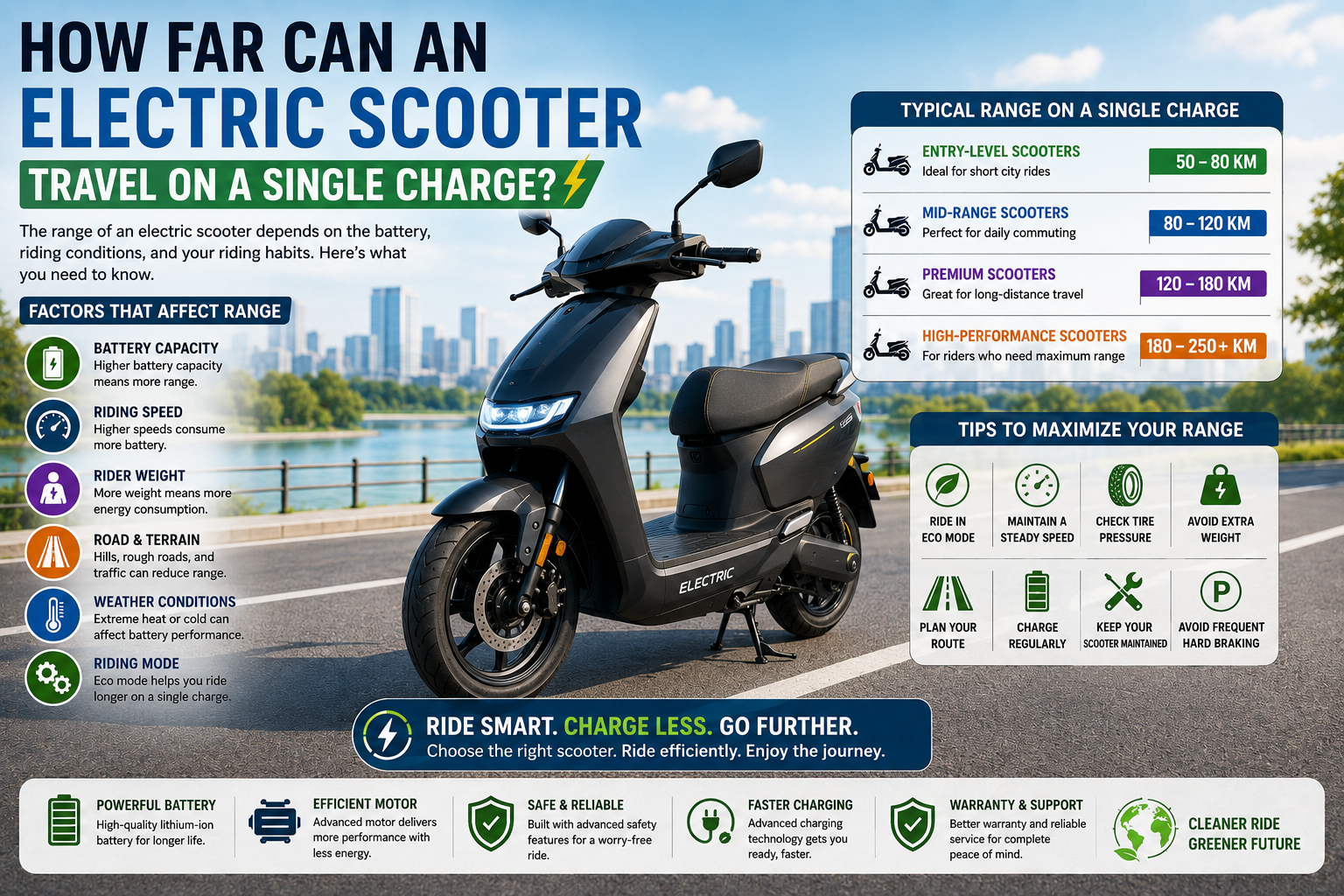
How Far Can an Electric Scooter Travel on a Single Charge?
One of the first questions people ask before buying an electric scooter is, “How far can it travel on a single charge?” It’s an important consideration because the riding range determines whether an electric scooter can meet your daily commuting needs.
The good news is that modern electric scooters have come a long way. Thanks to advancements in lithium-ion battery technology, efficient electric motors, and intelligent battery management systems, many of today’s models can comfortably handle daily city travel on a single charge.
However, the advertised range is only part of the story. Factors such as battery capacity, rider weight, road conditions, riding speed, weather, and maintenance all influence how far an electric scooter can actually travel.
In this guide, we’ll explore everything you need to know about electric scooter range, the factors that affect it, and how you can maximize every charge.
What Is Electric Scooter Range?
The range of an electric scooter refers to the maximum distance it can travel on a fully charged battery before it needs to be recharged.
Manufacturers usually test range under controlled conditions, which may include:
- Smooth roads
- Moderate riding speeds
- Average rider weight
- Favorable weather
- Eco riding mode
In real-world conditions, your actual range may vary depending on how and where you ride.
Typical Electric Scooter Range in 2026
Battery technology has improved significantly over the past few years, allowing many scooters to travel much farther than earlier models.
Typical ranges include:
Entry-Level Scooters
- Range: 50–80 km
- Best for short city commutes and students.
Mid-Range Scooters
- Range: 80–120 km
- Ideal for office commuters and everyday riders.
Premium Scooters
- Range: 120–180 km
- Suitable for long-distance commuters and frequent travelers.
High-Performance Models
- Range: 180–250 km or more
- Designed for riders who need maximum distance and performance.
The right choice depends on your daily travel requirements.
What Determines an Electric Scooter’s Range?
Several factors influence how far an electric scooter can travel on a single charge.
1. Battery Capacity
The battery is the single biggest factor affecting range.
A larger battery stores more energy, allowing the scooter to travel farther before recharging.
High-quality lithium-ion batteries offer:
- Better energy density
- Longer lifespan
- Faster charging
- Improved reliability
When comparing scooters, check both the battery capacity and the estimated riding range.
2. Rider Weight
The heavier the rider, the more energy the scooter needs to move.
For example:
- A lighter rider may achieve the manufacturer’s claimed range.
- A heavier rider may experience a shorter range.
This difference becomes more noticeable on steep roads or during frequent acceleration.
3. Riding Speed
Speed has a significant impact on battery consumption.
Most electric scooters are most efficient at moderate speeds.
Riding at maximum speed continuously can reduce the available range because the motor draws more power.
Using Eco Mode often helps extend battery life.
4. Road Conditions
Smooth roads require less energy than rough or uneven surfaces.
Road conditions that can reduce range include:
- Potholes
- Gravel
- Sand
- Wet roads
- Broken pavement
A well-maintained road allows the scooter to operate more efficiently.
5. Hills and Inclines
Climbing hills demands more power from the motor, increasing battery consumption.
Frequent uphill riding will naturally reduce the distance you can travel on a single charge.
Descending hills, however, requires less energy, and some scooters use regenerative braking to recover a small amount of energy.
6. Weather Conditions
Temperature affects battery performance.
Cold weather can temporarily reduce battery efficiency, while extremely hot conditions may affect long-term battery health.
Moderate temperatures generally provide the best performance and range.
7. Tire Pressure
Underinflated tires create more rolling resistance, forcing the motor to work harder.
Checking tire pressure regularly can improve:
- Battery efficiency
- Riding comfort
- Tire lifespan
- Overall range
Properly inflated tires are one of the simplest ways to maximize performance.
8. Riding Style
Aggressive riding drains the battery faster.
Rapid acceleration, sudden braking, and high-speed riding consume more energy than smooth, consistent acceleration.
Gentle riding habits help extend the distance traveled on a single charge.
9. Motor Efficiency
Modern electric motors are highly efficient.
Premium scooters often feature advanced motors that deliver strong performance while consuming less energy.
Choosing a well-designed motor can improve both performance and range.
10. Battery Management System (BMS)
A Battery Management System monitors and protects the battery.
It helps:
- Prevent overcharging
- Prevent deep discharge
- Balance battery cells
- Improve battery lifespan
- Optimize energy usage
A quality BMS contributes to consistent performance over time.
How to Increase Electric Scooter Range
If you want to travel farther on every charge, follow these practical tips:
Ride in Eco Mode
Eco Mode limits power output and conserves battery energy.
Avoid Sudden Acceleration
Smooth acceleration reduces energy consumption.
Maintain Proper Tire Pressure
Properly inflated tires reduce rolling resistance.
Reduce Extra Weight
Carrying fewer heavy items helps improve efficiency.
Charge Regularly
Avoid allowing the battery to remain fully discharged for extended periods.
Keep the Scooter Well Maintained
Routine maintenance ensures all components operate efficiently.
Plan Your Routes
Choosing flatter roads with fewer stops can increase range.
Charging Your Electric Scooter
Charging habits also influence battery performance.
Most modern scooters require:
- Standard Charging: 4–8 hours
- Fast Charging: 2–4 hours (depending on the model)
For the best results:
- Use the original charger.
- Avoid exposing the battery to extreme temperatures.
- Disconnect the charger once charging is complete if recommended by the manufacturer.
- Store the scooter in a cool, dry place.
Common Myths About Electric Scooter Range
Myth 1: Advertised Range Is Always Accurate
Real-world range depends on multiple factors and may differ from laboratory test results.
Myth 2: Bigger Motor Means Longer Range
A more powerful motor can improve performance, but range depends mainly on battery capacity and riding conditions.
Myth 3: Charging Overnight Damages the Battery
Most modern scooters include intelligent charging systems that protect the battery once it reaches full charge.
Myth 4: Electric Scooters Can’t Handle Daily Commuting
Many current models easily cover the average daily commute on a single charge.
Choosing the Right Range for Your Needs
When selecting an electric scooter, choose a range that exceeds your daily travel distance.
For example:
- Daily commute: 25 km → Choose a scooter with at least a 50–60 km range.
- Daily commute: 50 km → Consider an 80–120 km range.
- Daily commute: 80 km → Look for a scooter with a range of 120 km or more.
Having additional range provides flexibility and reduces charging frequency.
Frequently Asked Questions
How far can an electric scooter travel on one charge?
Depending on the model, modern electric scooters can typically travel between 50 km and 250 km on a fully charged battery.
Does speed affect electric scooter range?
Yes. Riding at higher speeds uses more battery power and usually reduces the total distance you can travel.
Can hills reduce battery range?
Yes. Riding uphill requires more energy from the motor, which can decrease the available range.
How long does it take to recharge an electric scooter?
Most scooters require between 4 and 8 hours for a full charge, while fast-charging models can charge in 2 to 4 hours.
Can I improve my scooter’s range?
Yes. Riding smoothly, maintaining proper tire pressure, using Eco Mode, and keeping your scooter well maintained can all help maximize battery range.
Conclusion
The distance an electric scooter can travel on a single charge depends on several factors, including battery capacity, rider weight, terrain, weather, speed, and riding habits. While many modern scooters offer impressive ranges that comfortably support daily commuting, understanding the real-world factors that influence battery performance is essential when choosing the right model.
For most riders, selecting an electric scooter with a range greater than their daily travel needs provides peace of mind and flexibility. Combined with good charging habits and regular maintenance, today’s electric scooters deliver reliable, efficient, and cost-effective transportation for urban life.
As battery technology continues to improve, future electric scooters will travel even farther on a single charge, making electric mobility an increasingly practical choice for commuters around the world.