EV Subsidy Telangana 2026: Electric Vehicle Subsidies, Road Tax Exemption & Registration Benefits


EV Subsidy Telangana 2026: Complete Guide for Electric Vehicle Buyers

Electric vehicles are becoming increasingly popular in Telangana, especially in Hyderabad and other major cities. Rising petrol prices, lower electric running costs, increasing charging infrastructure, and growing awareness of clean transportation are encouraging more people to consider electric scooters, motorcycles, cars, and commercial EVs.

One of the biggest questions buyers have in 2026 is simple:

“Is there an EV subsidy in Telangana?”

The answer needs some explanation because Telangana’s main state-level EV benefit has historically been structured differently from a direct cash discount. Under the Telangana Electric Vehicle & Energy Storage Policy 2020–2030, the state provides demand-side incentives that include a 100% exemption from road tax and registration fees for a specified number of eligible electric vehicles purchased and registered in Telangana.

However, the availability and implementation of these benefits can depend on the applicable government orders, vehicle category, and remaining eligible quota. In August 2026, reports also indicated that the Telangana government is considering extending its EV tax-waiver policy.

That makes it important for buyers to verify the latest benefit at the time of purchase and registration rather than assuming that every EV automatically receives a subsidy.

This guide explains what Telangana EV buyers should know in 2026.


What Is the EV Subsidy in Telangana?

When people search for “EV subsidy Telangana 2026,” they often expect a direct amount such as ₹10,000, ₹20,000, or ₹50,000 to be deducted from the vehicle price.

Telangana’s state policy is different.

The Telangana Electric Vehicle & Energy Storage Policy 2020–2030 provides demand-side incentives primarily through exemptions from road tax and registration fees for specified numbers of electric vehicles purchased and registered within the state.

For electric two-wheelers, the policy provides:

100% exemption of road tax and registration fee for the first 2,00,000 electric two-wheelers purchased and registered in Telangana.

This can reduce the buyer’s upfront on-road cost considerably.


Is There a Direct Cash Subsidy for Electric Scooters?

This is an important distinction.

A tax and registration exemption is not necessarily the same thing as a direct cash subsidy.

Under Telangana’s EV policy, the major consumer incentive is the exemption from road tax and registration charges for eligible vehicles within the specified quota.

Therefore, buyers should not automatically assume that the Telangana government will transfer a fixed cash amount into their bank account after buying an electric scooter.

Instead, the financial benefit may appear as reduced charges associated with vehicle registration and taxation.


Telangana EV Subsidy for Electric Two-Wheelers

Electric scooters and motorcycles are particularly important because they are among the most affordable EVs for everyday consumers.

The Telangana EV policy provides a 100% road tax and registration fee exemption for the first 2,00,000 electric two-wheelers purchased and registered within Telangana.

This can be valuable for buyers because registration and road-tax charges can add a noticeable amount to the on-road price of a vehicle.

For example, when comparing two scooters with similar ex-showroom prices, the electric scooter may have an advantage if the applicable state tax and registration charges are exempted.

Potential benefits include:

  • Lower on-road purchase cost
  • No applicable road tax during the exemption
  • Exemption from registration fee under the applicable incentive
  • Lower initial ownership expense
  • Reduced overall cost of switching to electric mobility

However, buyers should confirm the actual invoice and registration treatment with the authorized dealer and Telangana Transport Department before making payment.


Telangana EV Subsidy for Electric Cars

The state policy also provides incentives for electric private cars.

Under the Telangana EV & ESS Policy, 100% exemption of road tax and registration fee is provided for the first 5,000 electric four-wheeler private vehicles purchased and registered in Telangana.

This can make a significant difference because registration and road-tax costs for cars can be much higher than for two-wheelers.

For someone planning to purchase an electric car, checking whether the vehicle qualifies under the applicable Telangana incentive can therefore be an important part of calculating the final on-road cost.


Benefits for Commercial Electric Vehicles

Telangana’s EV policy also covers several commercial categories.

The policy provides a 100% road-tax and registration-fee exemption for the first:

  • 5,000 electric four-wheeler commercial passenger vehicles, such as taxis and tourist cabs
  • 10,000 electric light goods carriers, including eligible electric three-wheelers and e-carriers
  • 500 electric buses

This is particularly relevant for businesses considering electric mobility for delivery, logistics, transportation, and fleet operations.


Electric Three-Wheeler Incentives

Electric three-wheelers are also covered by the Telangana policy.

The policy provides 100% exemption of road tax and registration fee for the first 20,000 electric three-seater auto-rickshaws purchased and registered within Telangana.

In addition, the policy includes a retrofit incentive for the first 5,000 eligible retrofitted three-seater auto-rickshaws.

The retrofit incentive is 15% of the retrofitment cost, capped at ₹15,000 per vehicle.

These measures are designed to encourage the transition from conventional fuel-powered three-wheelers to electric mobility.


Does Telangana Have an EV Policy in 2026?

Yes. Telangana’s EV and Energy Storage Policy is titled the Telangana Electric Vehicle & Energy Storage Policy 2020–2030.

The policy outlines incentives for consumers as well as measures intended to support the wider EV ecosystem, including manufacturing, charging infrastructure, and investment.

The policy is therefore broader than simply providing a purchase subsidy.

It aims to encourage:

  • EV adoption
  • Local manufacturing
  • Charging infrastructure
  • Battery and energy-storage development
  • Investment
  • Clean transportation

Important 2026 Update: Tax-Waiver Extension

One of the most important points for anyone researching EV subsidy Telangana 2026 is that the status of the tax waiver is subject to current government decisions.

A report published on August 9, 2026 said the Telangana government was considering an extension of its tax-waiver policy for electric vehicles. The report noted that the government was evaluating the policy’s impact on EV adoption and environmental goals.

This means buyers should be careful with older online articles that state the exemption is automatically available without mentioning current implementation.

The safest approach is to confirm the benefit with:

  1. The authorized EV dealer
  2. Telangana Transport Department
  3. The registration authority handling the vehicle

before completing the purchase.


What About the Central Government EV Subsidy?

State incentives and central-government incentives are separate.

The central government introduced the PM E-DRIVE scheme to accelerate electric mobility. The official PM E-DRIVE portal states that the scheme aims to incentivize approximately 24.79 lakh electric two-wheelers equipped with advanced batteries.

However, official Ministry of Heavy Industries material states that the e-2W incentive deployment under PM E-DRIVE covered vehicles registered from April 1, 2024 to March 31, 2026.

Therefore, someone buying an electric scooter in Telangana during 2026 should not assume that the earlier PM E-DRIVE purchase incentive is still available for a new registration after March 31, 2026.

Always check the current central scheme status before calculating your expected subsidy.


Telangana EV Subsidy vs Central EV Incentive

It is useful to understand the difference.

BenefitTelanganaCentral Government
Main incentive typeRoad tax & registration exemptionDemand incentive under PM E-DRIVE
Electric scootersCovered under state policy quotaCovered under scheme eligibility during applicable period
Electric carsState policy provides exemption for specified quotaDifferent central provisions may apply
EligibilityPurchase and registration within TelanganaScheme-specific eligibility
AvailabilitySubject to applicable policy/orders and quotaScheme period and eligibility rules
Cash paymentNot the main Telangana mechanismIncentive structured through eligible vehicle purchase

The two systems should not be treated as identical.


How Much Can You Save?

The exact savings depend on the vehicle’s price, category, applicable tax rates, registration charges, and whether the exemption is available at the time of registration.

For example, suppose an electric scooter has an ex-showroom price of ₹1,20,000.

The final on-road price may normally include additional charges such as:

  • Registration fee
  • Road tax
  • Insurance
  • Accessories
  • Handling or other dealer charges, where applicable

If the applicable Telangana road-tax and registration exemptions are applied, the buyer may avoid some of those government charges.

The exact saving should be calculated from the dealer’s official quotation rather than using a fixed percentage.


How to Check Your EV Subsidy Eligibility

Before booking an EV, ask the dealer for a written quotation showing:

1. Ex-showroom price

This is the manufacturer’s listed selling price before applicable on-road charges.

2. Road tax

Ask whether Telangana’s EV exemption applies to your vehicle.

3. Registration fee

Confirm whether the applicable registration fee is fully exempt.

4. Insurance

Insurance is generally a separate ownership expense and should be included when calculating the full on-road price.

5. Other charges

Ask for a clear breakdown of additional charges.

A transparent quotation makes it easier to identify the actual value of the government incentive.


Documents You May Need

The exact documents depend on the dealer and registration process, but buyers commonly need documents such as:

  • Aadhaar or another accepted identity document
  • Address proof
  • PAN, where applicable
  • Vehicle invoice
  • Insurance documents
  • Dealer documentation
  • Registration-related forms

The dealer normally assists with the registration process.

Always provide accurate information and ensure that the registered address meets the applicable Telangana registration requirements.


Does Every Electric Scooter Get the Telangana Benefit?

Not necessarily.

Eligibility can depend on:

  • Vehicle category
  • Purchase date
  • Registration date
  • Registration location
  • Applicable government orders
  • Remaining incentive quota
  • Vehicle eligibility
  • Current policy implementation

The policy specifically describes incentives for the first 2,00,000 electric two-wheelers, rather than an unlimited exemption for every EV indefinitely.

This is why checking the current status before purchase is important.


How EV Subsidies Affect Electric Scooter Prices

Government incentives can make electric scooters more attractive compared with petrol scooters.

However, buyers should compare the total cost of ownership, not just the purchase price.

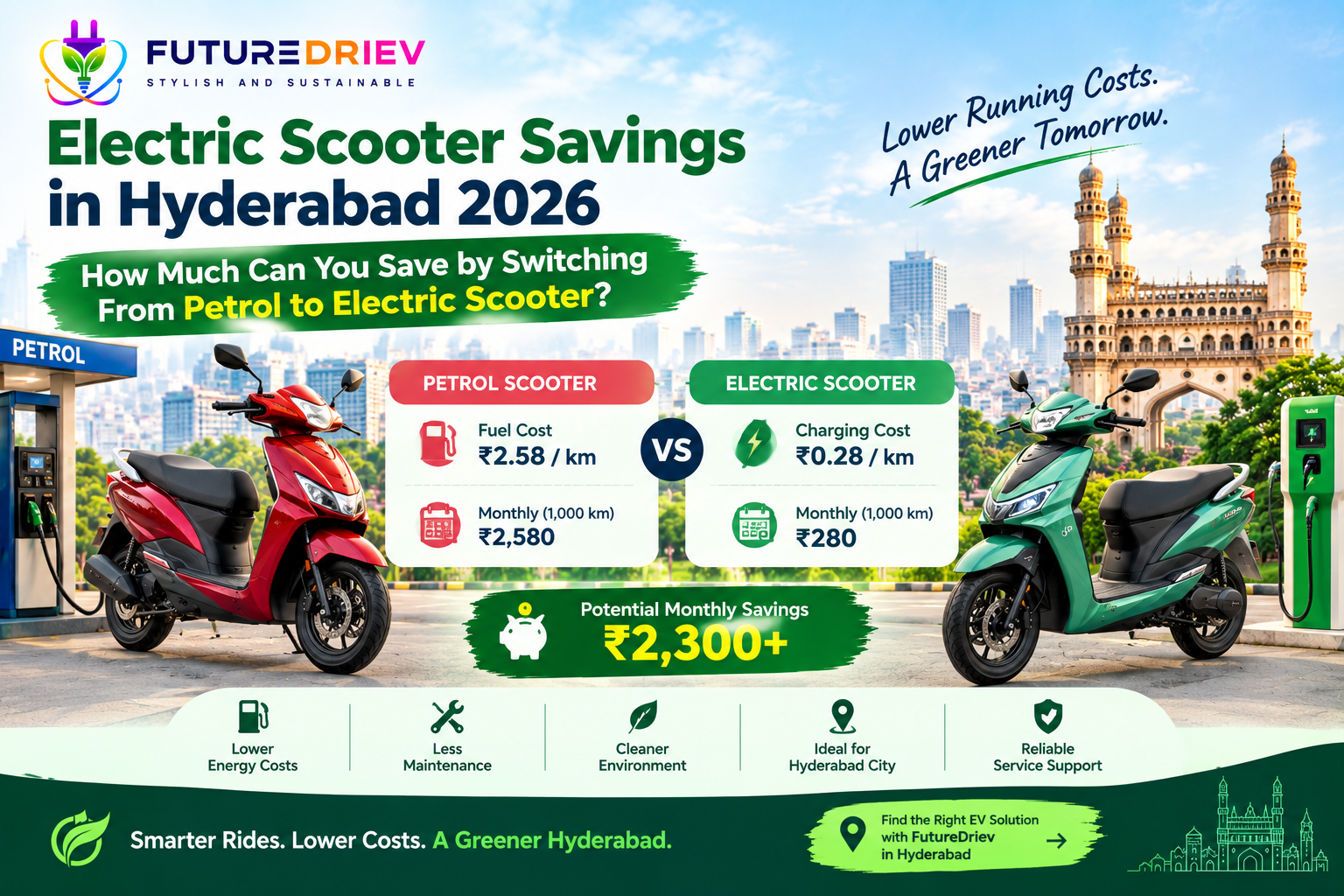
Electric scooters can also provide savings through:

  • Lower electricity costs
  • Reduced routine maintenance
  • No engine oil
  • Fewer mechanical components
  • Lower daily running costs

Over several years, these operating savings can become more important than the initial subsidy.


Things to Check Before Buying an EV in Telangana

Don’t choose an electric vehicle based only on subsidy.

Also consider:

Battery Warranty

Check the battery warranty period and coverage.

Real-World Range

Don’t rely exclusively on the manufacturer’s maximum claimed range.

Charging Time

Understand how long a full charge takes at home.

Service Network

Check the availability of authorized service centres in your city.

Spare Parts

Ask about the availability and cost of important replacement parts.

Insurance

Compare insurance coverage before finalizing your purchase.

Resale Value

Consider how the model’s battery technology and brand support could affect future resale.


Is Buying an Electric Scooter in Telangana Worth It in 2026?

For many commuters, an electric scooter can be a sensible choice even without a large direct cash subsidy.

The combination of:

  • Potential tax and registration benefits
  • Lower running costs
  • Lower maintenance requirements
  • Quiet operation
  • Zero tailpipe emissions
  • Convenient home charging

can make EV ownership attractive.

Hyderabad’s traffic also makes electric scooters practical for many short and medium-distance commutes.

However, buyers should calculate their daily travel distance and charging access before making a decision.


Frequently Asked Questions

Is there an EV subsidy in Telangana in 2026?

Telangana’s EV policy provides demand-side incentives, including 100% road-tax and registration-fee exemption for specified numbers of eligible EVs. For electric two-wheelers, the policy covers the first 2,00,000 vehicles purchased and registered in Telangana.

Is road tax waived for electric scooters in Telangana?

The Telangana EV policy provides 100% road-tax exemption for the specified eligible electric two-wheeler quota. Buyers should confirm the current implementation and remaining eligibility at registration.

Is registration free for EVs in Telangana?

The state policy provides 100% exemption from registration fees for specified eligible EV categories and quotas, including the first 2,00,000 electric two-wheelers.

Is PM E-DRIVE still available for electric scooters in 2026?

The Ministry of Heavy Industries states that the PM E-DRIVE e-2W incentive deployment covered vehicles registered between April 1, 2024 and March 31, 2026. Buyers purchasing after that period should verify whether any new central incentive or extension applies.

Can I get both central and Telangana EV benefits?

Potentially, if both programs are active and the vehicle meets their respective eligibility conditions. However, the central PM E-DRIVE e-2W incentive had a registration period ending March 31, 2026, according to official MHI material, so buyers in later 2026 should verify current eligibility.

How do I confirm the subsidy before buying?

Ask the authorized dealer to provide a detailed on-road quotation showing the applicable road-tax and registration exemption. You can also confirm the current position with the Telangana Transport Department.


Conclusion

The EV subsidy in Telangana in 2026 is best understood as a combination of state-level tax and registration benefits rather than simply a fixed cash subsidy.

The Telangana Electric Vehicle & Energy Storage Policy 2020–2030 provides 100% exemption from road tax and registration fees for the first 2,00,000 electric two-wheelers purchased and registered within Telangana, along with specified incentives for electric cars, commercial vehicles, three-wheelers, buses, and other categories.

At the same time, the policy’s implementation and future tax-waiver status are important considerations in 2026. Recent reporting says the Telangana government was considering extending the tax waiver, so buyers should verify the latest position before purchase.

The central PM E-DRIVE incentive should also be considered separately. Official Ministry of Heavy Industries information says the e-2W incentive period covered registrations through March 31, 2026.

If you’re planning to buy an electric scooter or car in Telangana, don’t focus only on the advertised subsidy. Compare the ex-showroom price, road tax, registration charges, insurance, charging cost, battery warranty, maintenance, and real-world range.

A properly calculated total cost of ownership will give you a much clearer picture of whether an EV is the right investment for your needs in 2026.

Best Electric Scooter for Hyderabad Traffic: Top Choices for City Riding in 2026


Best Electric Scooter for Hyderabad Traffic

Hyderabad is a fast-growing city where daily commuting can involve busy junctions, stop-and-go traffic, flyovers, uneven roads, long-distance commutes, and crowded market areas. For many riders, an electric scooter can be a practical alternative to a petrol scooter because it offers quiet operation, instant torque, and potentially lower running costs.

But choosing the best electric scooter for Hyderabad traffic isn’t simply about looking for the highest claimed range or fastest top speed. A good city scooter needs to be comfortable in slow-moving traffic, easy to handle, capable of dealing with flyovers and inclines, practical for daily errands, and supported by a dependable service network.

In 2026, buyers in Hyderabad have several strong options, including the TVS iQube, Ather Rizta, Bajaj Chetak, and Ola S1 Pro. Each one has a different strength.

For most Hyderabad commuters, the TVS iQube is one of the strongest all-round choices because of its practical design, multiple battery options, comfortable city-oriented performance, storage, connected features, and broad service presence. However, the Ather Rizta, Bajaj Chetak, and Ola S1 Pro can make more sense depending on your priorities.

Let’s compare them in detail.


What Makes a Good Electric Scooter for Hyderabad?

Before choosing a scooter, think about the conditions you experience every day.

A Hyderabad commuter may need to deal with:

  • Heavy peak-hour traffic
  • Frequent braking and acceleration
  • Flyovers and inclines
  • Uneven road surfaces
  • Long daily commutes
  • Hot weather
  • Occasional heavy rain
  • Limited parking space
  • Pillion riding
  • Grocery and luggage carrying

Because of these conditions, the following features are particularly important.

1. Realistic Range

Don’t choose a scooter solely because of its advertised maximum range. Official IDC figures are obtained under standardized conditions, while real-world range varies according to speed, rider weight, traffic, temperature, terrain, tyre pressure, and riding mode.

For Hyderabad commuting, choose a battery that gives you a comfortable margin above your normal daily distance.

If you travel 40–50 km every day, a scooter with a claimed range comfortably above that figure is preferable to one that requires frequent charging.


2. Comfortable Ride Quality

Hyderabad has a mixture of smooth roads, rough patches, speed breakers, and uneven surfaces.

A good electric scooter should have:

  • Comfortable suspension
  • Stable handling
  • Good-quality tyres
  • Effective braking
  • A comfortable seat
  • Adequate ground clearance

These characteristics become especially important when riding for extended periods.


3. Easy Handling in Traffic

Heavy traffic requires a scooter that is predictable and easy to control.

Strong low-speed acceleration can help when moving through gaps in traffic, while smooth throttle response makes repeated stop-and-go riding less tiring.

You don’t necessarily need a scooter with extreme performance.

For city commuting, controlled acceleration and easy handling are often more useful than very high top speed.


4. Battery and Charging Convenience

Home charging is one of the biggest advantages of owning an electric scooter.

Before buying, check:

  • Battery capacity
  • Charging time
  • Charger portability
  • Charging locations near your home and workplace
  • Battery warranty
  • Charging requirements

For example, the current TVS iQube range includes battery options from 2.2 kWh to 5.3 kWh, with claimed IDC ranges from 94 km to 212 km depending on variant.


5. Service Network

Service availability matters just as much as specifications.

Even a technically impressive scooter can become inconvenient if getting spare parts or repairs takes too long.

Before purchasing, identify the nearest authorized service centre and check whether it is convenient from your home or workplace.


Top Electric Scooters for Hyderabad Traffic

1. TVS iQube – Best All-Rounder for Hyderabad

The TVS iQube is one of the most practical electric scooters for Hyderabad commuters.

TVS currently offers multiple iQube variants, including 2.2 kWh, 3.1 kWh, 3.5 kWh, 4.7 kWh and 5.3 kWh versions. Depending on the variant, claimed IDC range goes from 94 km to 212 km, with top speeds reaching up to 82 km/h.

The scooter is designed around everyday usability rather than extreme performance.

Why it works well in Hyderabad

The iQube offers:

  • Smooth acceleration
  • Comfortable city performance
  • Multiple battery choices
  • Large storage on selected variants
  • Connected features
  • Turn-by-turn navigation on supported versions
  • Hill-hold functionality on selected variants

TVS describes the iQube as a family-oriented electric scooter with connected features and access to a large charging network.

The iQube’s city-focused character makes it particularly suitable for commuters who want a straightforward daily scooter.

Best for:

Daily commuters, families, office workers, and riders who prioritize practicality.


2. Ather Rizta – Best for Comfort and Family Use

The Ather Rizta is another excellent option for Hyderabad traffic, particularly if comfort and practicality are your priorities.

Ather lists the Rizta with an IDC range of up to 161 km depending on battery configuration, an 80 km/h top speed, 34 litres of boot space, 12-inch tubeless tyres, front disc braking, and a monoshock rear suspension.

That 34-litre storage capacity is especially useful for everyday city life.

You can use the storage space for:

  • Shopping bags
  • Work equipment
  • Rain gear
  • Helmets
  • Personal belongings

The Rizta also offers features such as navigation, multiple riding modes, AutoHold, and connected technology depending on variant.

Why it works well in Hyderabad

Its family-oriented design makes it suitable for:

  • Office commuting
  • College travel
  • Shopping trips
  • Pillion riding
  • Everyday errands

The scooter also has an IPX7-rated battery and IP67-rated motor according to Ather’s current specifications, which are useful features for a scooter used in varying weather conditions.

Best for:

Families, comfortable commuting, storage, and everyday practicality.


3. Bajaj Chetak – Best for Solid Build and City Riding

The Bajaj Chetak is another strong choice for riders who prefer a robust, traditional scooter feel combined with electric power.

Bajaj’s current C Series includes the C35, C30, and C25. In April 2026, Bajaj announced updates including higher top speeds on several variants, ride modes, hill-hold assist, and integrated Google Maps on the flagship C35 01.

The C25, for example, uses a 2.5 kWh battery and has a claimed range of up to 113 km. Bajaj describes it as designed for busy urban streets and easy everyday movement.

Why it works well in Hyderabad

The Chetak is attractive for riders who want:

  • Solid construction
  • Easy city riding
  • Comfortable everyday performance
  • Traditional scooter proportions
  • Useful technology
  • Hill-hold assistance on supported models

The newer C Series also gives buyers more choice depending on their budget and range requirements.

Best for:

Riders who value build quality, city usability, and a familiar scooter experience.


4. Ola S1 Pro – Best for Range and Performance

If range and performance are your biggest priorities, the Ola S1 Pro deserves consideration.

Current 2026 comparisons list the S1 Pro among India’s highest-range electric scooters, with some variants offering very high claimed range figures.

Its performance advantage can be useful when:

  • Climbing flyovers
  • Joining faster roads
  • Carrying a pillion
  • Making longer commutes

However, performance shouldn’t be the only factor when selecting a scooter for Hyderabad.

Before buying an Ola, check the availability and convenience of the nearest service centre and consider owner feedback in your area.

Best for:

Riders who prioritize range, acceleration, features, and performance.


Quick Comparison

ScooterBest ForMain Strength
TVS iQubeDaily commutingAll-round practicality
Ather RiztaFamiliesComfort and storage
Bajaj ChetakCity ridingBuild and urban usability
Ola S1 ProLong ridesRange and performance

Specifications and prices can change between variants and over time, so check the manufacturer’s current Hyderabad pricing before booking.


Which Electric Scooter Is Best for Hyderabad Traffic?

If your main requirement is daily city commuting, the TVS iQube is a particularly strong choice.

Why?

Because Hyderabad traffic doesn’t require extreme speed every day. Instead, commuters need:

  • Smooth acceleration
  • Comfortable suspension
  • Good range
  • Easy handling
  • Practical storage
  • Reliable charging
  • Useful technology
  • Convenient service support

The iQube combines these requirements well.

For example, the current iQube ST 5.3 kWh has a claimed 212 km IDC range and an 82 km/h top speed, while the 3.5 kWh version has a claimed 145 km IDC range.

That means buyers can select a battery size based on their actual commuting needs rather than paying for range they may never use.


Best Electric Scooter for Different Hyderabad Riders

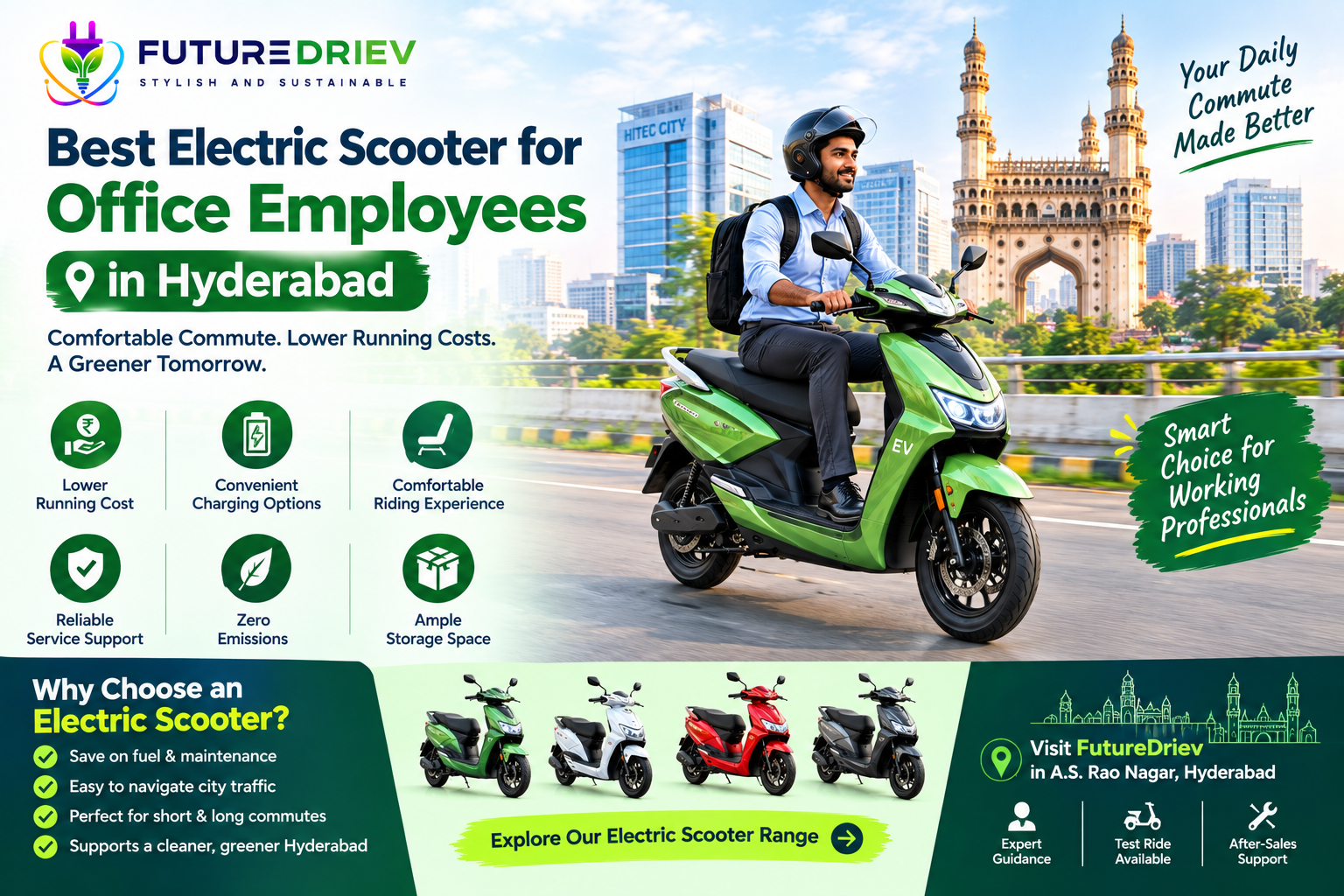
For Office Commuters

Recommended: TVS iQube

It provides a practical combination of range, comfort, storage, and connected features.


For Families

Recommended: Ather Rizta

Its spacious design and 34-litre boot make it particularly convenient for family use.


For Build Quality

Recommended: Bajaj Chetak

The Chetak is a good option if you prefer a solid, conventional scooter feel.


For Long-Distance Commuters

Recommended: TVS iQube ST or Ola S1 Pro

Choose based on your preferred balance between range, performance, service convenience, and budget.


What Range Do You Really Need?

Suppose your daily commute is:

20 km one way × 2 = 40 km per day

Over five working days, that’s approximately:

200 km per week.

You don’t necessarily need a scooter with a 200 km real-world range because you can recharge overnight.

A scooter with sufficient practical range for your daily routine can be more economical than paying extra for a very large battery.

Always leave a safety margin for:

  • Unexpected trips
  • Traffic
  • Weather
  • Battery degradation
  • Detours
  • Reduced efficiency

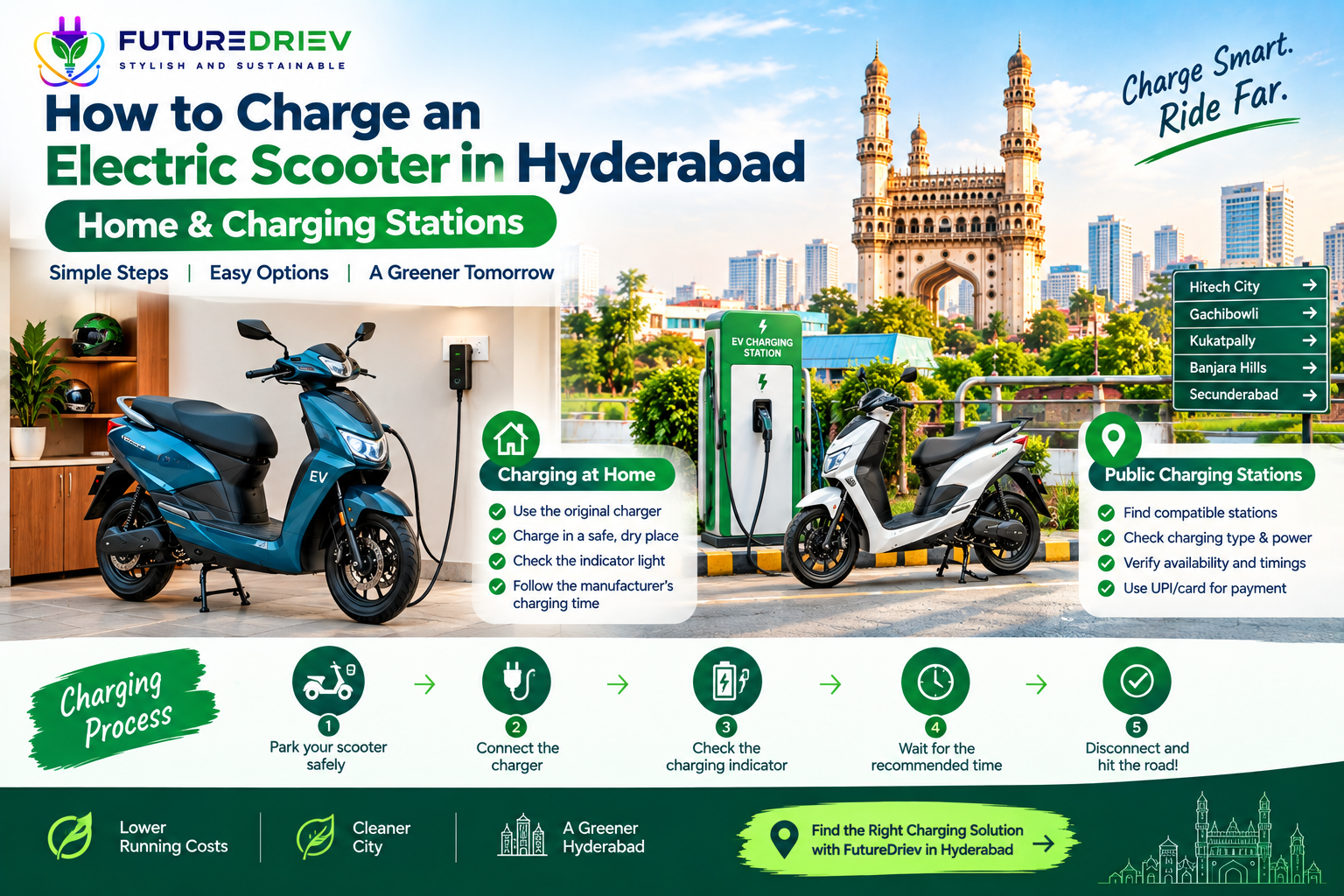
Charging Tips for Hyderabad Riders

Charging at home is usually the most convenient approach.

Try to:

  1. Charge in a safe, dry location.
  2. Use the manufacturer’s charger.
  3. Avoid exposing charging equipment to water.
  4. Follow the manufacturer’s recommended charging practices.
  5. Monitor battery health.
  6. Plan charging around your daily commute.

If your workplace has charging facilities, that can further reduce range anxiety.

Some scooters also support access to public charging networks, which can be useful for longer journeys.


Is an Electric Scooter Good for Hyderabad Roads?

Yes, but the right model matters.

A city scooter should have adequate ground clearance, good suspension, strong brakes, and quality tyres.

You should also ride carefully over:

  • Potholes
  • Speed breakers
  • Waterlogged sections
  • Loose gravel
  • Uneven surfaces

Even a premium electric scooter cannot compensate for unsafe riding.


Things to Check Before Buying

Before booking your electric scooter, take a proper test ride.

Pay attention to:

Ride Comfort

Does the suspension handle rough roads comfortably?

Throttle Response

Is acceleration smooth in slow-moving traffic?

Braking

Can you brake confidently without excessive sensitivity?

Seat Comfort

Will the seat remain comfortable during a 30–60 minute commute?

Storage

Can it carry your helmet, charger, bag, or shopping?

Service Centre

Is an authorized service centre conveniently located?

Charging

Can you charge easily at home?

These practical factors are more important than simply comparing brochure numbers.


Final Verdict

The best electric scooter for Hyderabad traffic depends on your commuting distance, budget, family requirements, and riding preferences.

For most everyday commuters, the TVS iQube stands out as a strong all-round option because it combines practical city performance, multiple battery choices, useful technology, storage, and a broad support ecosystem.

The Ather Rizta is a great alternative for families and riders who prioritize comfort and storage.

The Bajaj Chetak is worth considering if you want solid construction and an easy urban riding experience, while the Ola S1 Pro is more appealing if range and performance are your top priorities.

Before making your final decision, compare the Hyderabad on-road price, battery size, realistic range, charging time, warranty, service availability, and EMI options for the exact variant you want.

The best electric scooter isn’t necessarily the one with the biggest battery or fastest acceleration. It is the one that fits your daily Hyderabad commute comfortably, reliably, and economically.


Frequently Asked Questions

Which is the best electric scooter for Hyderabad traffic?

The TVS iQube is one of the strongest all-round choices for Hyderabad because of its practical performance, comfort, multiple battery options, storage, and connected features.

Is Ather Rizta good for Hyderabad?

Yes. The Rizta’s comfortable design, 34-litre storage, 12-inch tyres, 80 km/h top speed, and available 123/161 km IDC range make it well suited to everyday urban commuting.

Which electric scooter is best for long-distance commuting?

Models such as the TVS iQube ST and Ola S1 Pro are worth considering when longer range is a priority. Compare real-world range rather than relying only on claimed figures.

Is an electric scooter suitable for Hyderabad traffic?

Yes. Electric scooters can be particularly convenient in stop-and-go city traffic because of their quiet operation and instant electric torque.

Should I buy an electric scooter for daily office travel?

If you have convenient home charging and your daily travel distance fits comfortably within the scooter’s practical range, an electric scooter can be an economical option for regular commuting.

Sampath – Founder of FutureDriev and Driving Electric Mobility in Hyderabad

A Vision for Sustainable Electric Mobility

Sampath, the Founder of FutureDriev, is passionate about creating a cleaner, smarter, and more sustainable future through electric mobility. Based in Hyderabad, Telangana, he focuses on making electric transportation more accessible, practical, and affordable for individuals and businesses. Through FutureDriev, Sampath aims to provide reliable electric vehicles that combine modern technology, efficient performance, comfort, and cost-effective operation.

Building FutureDriev in Hyderabad

Hyderabad is a rapidly developing city with increasing demand for convenient and sustainable transportation. Rising fuel costs, traffic congestion, and growing environmental awareness are encouraging commuters and businesses to explore alternatives to conventional petrol and diesel vehicles. Sampath recognized this changing transportation landscape and established FutureDriev with a vision of supporting Hyderabad’s transition toward electric mobility.

FutureDriev is located at Plot No. 18, Sainik Enclave, near Netaji Nagar X Road and Toppers Junior College, Sainikpuri, AS Rao Nagar, Kapra, Medchal-Malkajgiri District, Telangana – 500094. The company serves customers in Hyderabad and surrounding areas with electric mobility solutions for personal and commercial transportation.

Promoting Electric Two-Wheelers in Hyderabad

One of Sampath’s key areas of focus is electric two-wheelers. Electric scooters are becoming increasingly popular among Hyderabad commuters because they can provide economical and convenient transportation for everyday journeys. Students, professionals, families, and delivery riders can benefit from lower running costs, reduced maintenance requirements, and a comfortable riding experience.

FutureDriev focuses on electric scooters designed for urban travel, efficient battery performance, smooth riding, and modern technology. Sampath believes that an electric scooter should not only be environmentally friendly but should also provide practical performance for everyday users.

Supporting Commercial Electric Mobility

Sampath’s vision also extends to commercial transportation. Businesses involved in passenger transportation, deliveries, logistics, and local services require dependable vehicles with affordable operating costs. Electric three-wheelers can provide an effective solution by reducing fuel expenses and maintenance requirements.

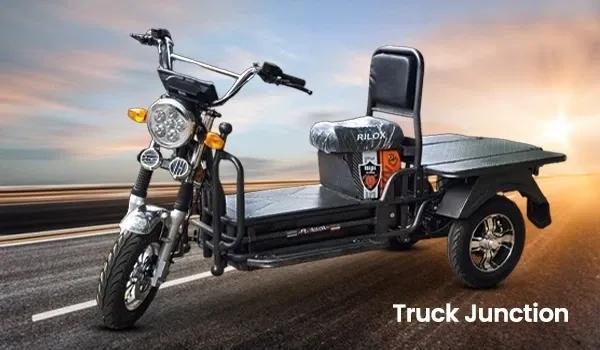
FutureDriev offers electric mobility solutions such as the Bijli Trio EV, designed for efficient and dependable commercial transportation. With electric power, efficient battery performance, lower operating costs, and reduced environmental impact, the Bijli Trio can support businesses looking for a more economical and sustainable transportation option.

Commitment to Eco-Friendly Transportation

Environmental sustainability is an important part of Sampath’s vision for FutureDriev. Conventional petrol and diesel vehicles contribute to air pollution and greenhouse gas emissions. Electric vehicles provide an opportunity to reduce dependence on fossil fuels and support cleaner urban transportation.

Sampath believes Hyderabad’s future mobility should be cleaner and more energy efficient. By promoting electric scooters and electric three-wheelers, FutureDriev contributes to the growing adoption of sustainable transportation across Hyderabad.

Advanced Technology and Reliable Performance

Electric vehicle technology continues to develop rapidly, with improvements in batteries, electric motors, charging systems, safety features, and vehicle design. Sampath focuses on combining these developments with practical customer requirements.

FutureDriev’s electric mobility solutions emphasize factors such as battery efficiency, comfortable riding, reliable performance, smart technology, and convenient charging. The objective is to make modern EV technology easier for customers to understand and use in their everyday lives.

Customer-Focused Electric Mobility

For many customers, purchasing an electric vehicle is an important decision. First-time EV buyers may have questions about battery life, charging time, driving range, maintenance, performance, and ownership costs. Sampath believes customers should receive clear information and appropriate guidance before selecting an electric vehicle.

FutureDriev therefore focuses on customer support throughout the buying and ownership journey. Customers can receive guidance about selecting suitable EV solutions according to their personal commuting or commercial transportation requirements.

Serving Sainikpuri, AS Rao Nagar and Hyderabad

FutureDriev’s location in Sainikpuri, AS Rao Nagar, Kapra, Hyderabad makes it convenient for customers in nearby areas to explore electric mobility solutions. The company also aims to serve customers across Medchal-Malkajgiri, Kompally, Sainikpuri, AS Rao Nagar, Kapra, and other parts of Hyderabad.

As awareness of electric mobility continues to increase throughout Hyderabad, Sampath is focused on making sustainable transportation solutions more accessible to local commuters, families, and businesses.

Sampath's Vision for the Future

Sampath believes the future of transportation will become increasingly electric. His vision for FutureDriev goes beyond providing vehicles; it is about helping customers understand the practical advantages of switching to electric mobility.

His focus on sustainable transportation, customer satisfaction, innovative technology, and economical mobility reflects the changing transportation requirements of Hyderabad. Through FutureDriev, Sampath continues to work toward making electric vehicles a practical choice for everyday travel and commercial operations.

Electric Scooter Financing: Is EMI Worth It? A Complete Buyer’s Guide for 2026

Electric Scooter Financing: Is EMI a Good Option?

Electric scooters have become one of the fastest-growing modes of transportation worldwide. With rising fuel prices, increasing environmental awareness, and government support for electric mobility, more people are choosing electric scooters over traditional petrol-powered vehicles. They offer lower running costs, reduced maintenance, and an eco-friendly way to commute.

However, while electric scooters save money over time, the initial purchase price can still be a significant investment for many buyers. Premium models with longer battery ranges, advanced safety features, and smart technology often come with higher price tags. This is where Electric Scooter Financing and Equated Monthly Installments (EMIs) have become popular options.

Instead of paying the entire amount upfront, financing allows buyers to spread the cost over several months or years through manageable monthly payments. But is choosing EMI really the smartest financial decision?

In this guide, we’ll explain how electric scooter financing works, explore its advantages and disadvantages, compare EMI with full payment, and help you decide whether financing is the right option for your budget and lifestyle.


What Is Electric Scooter Financing?

Electric scooter financing is a payment option that allows customers to purchase a scooter by paying a small amount upfront—sometimes called a down payment—and then repaying the remaining balance through monthly installments.

These installments usually include:

  • Principal loan amount
  • Interest (if applicable)
  • Processing fees (where applicable)
  • Taxes or additional charges depending on the lender

Financing makes electric scooters more accessible for buyers who may not want to spend a large amount of money all at once.

Many dealerships, banks, financial institutions, and digital lending platforms now offer financing solutions specifically designed for electric vehicles.


Understanding EMI

EMI stands for Equated Monthly Installment.

It is a fixed payment made every month until the loan is fully repaid.

Each EMI generally consists of:

  • A portion of the loan principal
  • Interest charged by the lender

As repayments continue, the proportion of principal increases while the interest portion gradually decreases.

Knowing your monthly EMI before purchasing helps you plan your finances more effectively.


How Electric Scooter Financing Works

The financing process is generally straightforward.

Step 1: Choose Your Scooter

Select the electric scooter model that best suits your commuting needs, riding range, budget, and desired features.

Step 2: Select a Financing Partner

You may finance your purchase through:

  • Banks
  • Credit unions
  • Vehicle finance companies
  • Manufacturer finance programs
  • Online lending platforms
  • Dealership financing

Each provider may offer different interest rates, repayment terms, and eligibility criteria.

Step 3: Submit Your Application

The lender usually reviews:

  • Identity verification
  • Address proof
  • Income documents
  • Employment details
  • Credit history (where applicable)

Approval timelines vary depending on the lender and documentation.

Step 4: Loan Approval

If approved, the lender finances the agreed amount, and you begin paying monthly EMIs according to the repayment schedule.


Types of Electric Scooter Financing

Several financing options are available depending on your financial situation.

1. Bank Loans

Banks often provide competitive interest rates and structured repayment plans.

Advantages:

  • Trusted institutions
  • Transparent terms
  • Flexible repayment periods

Possible drawbacks include stricter eligibility requirements and longer approval times.


2. Dealer Financing

Many electric scooter dealerships partner with financial institutions to provide on-the-spot financing.

Benefits include:

  • Faster approval
  • Convenient documentation
  • Promotional offers
  • Seasonal discounts

Always review the loan terms carefully before signing.


3. Digital Lending Platforms

Online financing platforms have simplified vehicle financing.

Benefits:

  • Quick application process
  • Digital document submission
  • Faster approvals
  • Convenient repayment management

Interest rates and fees may vary depending on the provider.


4. Credit Card EMI

Some buyers choose to convert their scooter purchase into monthly installments using a credit card.

Advantages include:

  • Instant financing
  • Promotional no-cost EMI offers
  • Flexible repayment tenure

Ensure you understand any associated fees or interest before choosing this option.


Benefits of Buying an Electric Scooter on EMI

Financing offers several advantages, especially for buyers who want to preserve their savings.

Lower Upfront Investment

Rather than paying the full purchase price immediately, EMI allows you to spread the cost over time.

This makes premium scooters more affordable.


Better Cash Flow Management

Instead of using all your available savings, you can maintain financial flexibility for:

  • Emergency expenses
  • Household costs
  • Investments
  • Education
  • Travel

Monthly payments are often easier to manage than a large one-time purchase.


Access to Better Models

Financing allows many buyers to purchase a scooter with:

  • Longer battery range
  • Faster charging
  • Advanced safety systems
  • Smart connectivity
  • Better warranty coverage

Rather than settling for a basic model, buyers may choose one that better suits their long-term needs.


Predictable Monthly Budget

EMIs provide consistent monthly payments, making budgeting simpler.

Knowing your repayment amount in advance helps avoid unexpected financial surprises.


Opportunity to Build Credit History

Making timely EMI payments may contribute positively to your credit profile, depending on your country’s financial reporting system.

Responsible repayment habits can improve future borrowing opportunities.


Is EMI Always the Best Option?

Although financing offers many benefits, it isn’t the ideal solution for everyone.

Before applying, consider whether monthly repayments comfortably fit within your financial situation.

Avoid committing to EMIs that place unnecessary pressure on your monthly budget.

A good rule is to ensure that your transportation expenses remain manageable alongside other financial responsibilities.


Factors to Consider Before Choosing EMI

Before financing your electric scooter, evaluate the following:

Total Cost of Ownership

Remember that owning a scooter involves more than just loan repayments.

Additional expenses may include:

  • Insurance
  • Registration fees
  • Accessories
  • Charging costs
  • Routine maintenance
  • Protective riding gear

Understanding the complete ownership cost helps prevent financial strain.


Loan Tenure

Financing plans often offer different repayment periods.

A longer tenure may reduce monthly EMIs but can increase the total interest paid over the life of the loan.

A shorter tenure generally results in higher monthly payments but lower overall financing costs.

Choose a repayment period that balances affordability with total cost.


Interest Rate

The interest rate significantly affects the total amount you’ll repay.

Even a small difference in interest rates can impact long-term financing expenses.

Compare offers from multiple lenders before making a decision.


Down Payment

Some financing options require an initial payment.

A larger down payment can:

  • Reduce your monthly EMI
  • Lower the total loan amount
  • Decrease overall interest costs

If your budget allows, paying more upfront may result in greater long-term savings.


EMI vs Full Payment

Both financing and paying in full have advantages.

Buying on EMI

Pros

  • Lower upfront cost
  • Better cash flow
  • Easier budgeting
  • Access to premium models

Cons

  • Monthly repayment commitment
  • Possible interest costs
  • Total purchase price may be higher over time

Paying in Full

Pros

  • No monthly installments
  • No financing charges
  • Immediate ownership without loan obligations

Cons

  • Large upfront expense
  • Reduced available savings
  • Less financial flexibility after purchase

The right choice depends on your financial goals, available savings, and monthly income.


Common Financing Mistakes to Avoid

Many buyers make avoidable mistakes during the financing process.

Common errors include:

  • Focusing only on the monthly EMI
  • Ignoring total repayment cost
  • Not comparing multiple lenders
  • Choosing an unnecessarily long repayment period
  • Overlooking processing fees
  • Borrowing beyond their budget

Carefully reviewing the loan agreement helps prevent costly surprises.

Hidden Costs of Electric Scooter Financing

While EMI makes purchasing an electric scooter more affordable, it’s important to understand the additional costs that may be included in your financing agreement. Looking beyond the monthly installment helps you make a smarter financial decision.

1. Interest Charges

The interest rate is one of the biggest factors affecting the total cost of your scooter. Even if the monthly EMI looks affordable, a high interest rate can significantly increase the total amount you repay over the loan period.

Before signing any agreement, calculate:

  • Total loan amount
  • Interest payable
  • Total repayment amount

Always compare offers from different lenders to find the most competitive rate.


2. Processing Fees

Many lenders charge a one-time processing fee to cover administrative costs.

These fees may be:

  • A fixed amount
  • A percentage of the loan value

Although processing fees are usually small, they should still be considered when comparing financing options.


3. Late Payment Charges

Missing an EMI payment may result in:

  • Penalty fees
  • Additional interest
  • Negative impact on your credit score
  • Collection notices

Setting up automatic payments can help you avoid missed due dates.


4. Insurance Requirements

Some lenders require comprehensive insurance while the loan is active.

Although insurance protects your investment, it also increases the overall ownership cost.


5. Extended Warranty and Add-ons

Dealerships may offer optional products such as:

  • Extended warranties
  • Roadside assistance
  • Service packages
  • Theft protection plans

These extras can provide value but should only be purchased if they fit your needs and budget.


Tips for Choosing the Best EMI Plan

Selecting the right financing option can save money over the life of the loan.

Compare Multiple Lenders

Never accept the first offer without checking alternatives.

Compare:

  • Interest rates
  • Processing fees
  • Loan tenure
  • Prepayment options
  • Customer service
  • Hidden charges

A little research can lead to significant savings.


Make a Larger Down Payment

If possible, pay a higher amount upfront.

Benefits include:

  • Lower monthly EMI
  • Reduced loan balance
  • Lower interest costs
  • Faster repayment

Even a modest increase in your down payment can reduce the overall cost of financing.


Choose the Right Loan Tenure

Longer repayment periods reduce monthly installments but often increase total interest.

Shorter tenures:

  • Cost less overall
  • Build equity faster
  • Help you become debt-free sooner

Select a repayment period that balances affordability with long-term savings.


Read the Fine Print

Always review the financing agreement carefully.

Look for:

  • Hidden fees
  • Prepayment penalties
  • Foreclosure charges
  • Insurance conditions
  • Default clauses

Understanding the terms before signing can help you avoid unexpected expenses later.


Who Should Buy an Electric Scooter on EMI?

Financing isn’t the right solution for everyone, but it can be an excellent option for many buyers.

EMI May Be Ideal If You:

  • Have a stable monthly income
  • Prefer predictable monthly payments
  • Want to preserve your savings
  • Need reliable transportation immediately
  • Plan to use the scooter for daily commuting
  • Qualify for a low-interest financing plan

For these buyers, financing offers flexibility while making electric mobility more accessible.


When Paying in Full Might Be Better

If you have enough savings without affecting your emergency fund or financial goals, paying the full amount upfront can offer several advantages.

Benefits include:

  • No monthly obligations
  • No financing interest
  • Simpler ownership
  • Lower overall purchase cost

Choosing between EMI and full payment ultimately depends on your financial situation and priorities.


Advantages of Financing an Electric Scooter

Electric scooter financing has become increasingly popular because it offers several practical benefits.

Key Advantages

  • Affordable monthly payments
  • Better cash flow management
  • Access to premium scooter models
  • Easier budgeting
  • Opportunity to build credit history
  • Immediate ownership without waiting to save the full amount
  • Flexible repayment options from many lenders

These advantages make financing attractive for first-time buyers and professionals alike.


Disadvantages of EMI Financing

Despite its benefits, financing also comes with potential drawbacks.

Possible Disadvantages

  • Higher total purchase cost due to interest
  • Monthly financial commitment
  • Risk of late payment penalties
  • Loan approval requirements
  • Processing and documentation fees
  • Reduced flexibility if income changes unexpectedly

Understanding both the advantages and disadvantages helps you make a balanced decision.


Frequently Asked Questions

Is buying an electric scooter on EMI a good idea?

For many buyers, yes. EMI makes electric scooters more affordable by spreading the purchase cost over several months or years. The best option depends on your income, savings, and financing terms.


Is a zero-interest EMI really free?

Some promotional “zero-interest” offers may include processing fees or adjusted product pricing. Always review the complete financing agreement before accepting the offer.


Can I repay my loan early?

Many lenders allow early repayment, though some may charge a prepayment or foreclosure fee. Check your loan agreement for details.


Does financing affect my credit score?

Yes. Making EMI payments on time can strengthen your credit history, while missed or delayed payments may negatively impact your credit profile.


How much down payment should I make?

A larger down payment generally reduces your loan amount, lowers your monthly EMI, and decreases the total interest paid. Choose an amount that fits comfortably within your budget while maintaining sufficient emergency savings.


The Future of Electric Scooter Financing

As electric mobility continues to grow, financing options are becoming more flexible and customer-friendly.

Emerging trends include:

  • Instant digital loan approvals
  • Paperless financing applications
  • AI-powered credit assessments
  • Subscription-based scooter ownership
  • Battery leasing programs
  • Flexible monthly payment plans
  • Manufacturer-sponsored low-interest financing
  • Buy Now, Pay Later (BNPL) options for electric vehicles

These innovations are making electric scooters more accessible to a wider range of consumers.


Final Thoughts

Electric scooter financing has opened the door for many people to enjoy the benefits of clean, affordable, and efficient transportation without paying the full purchase price upfront. EMI plans provide flexibility, improve cash flow, and make higher-quality scooters accessible to more buyers.

However, financing should never be chosen based solely on a low monthly installment. It’s important to compare lenders, understand the total repayment amount, evaluate interest rates, and read the loan terms carefully. A well-planned EMI can be a smart financial decision, while an unsuitable loan can become a long-term burden.

Before making your purchase, assess your monthly income, existing financial commitments, and long-term goals. If the EMI comfortably fits your budget and the financing terms are favorable, choosing an EMI plan can be an excellent way to invest in an electric scooter while preserving your savings.

Ultimately, the best financing decision is one that balances affordability, flexibility, and financial responsibility.


Call to Action

Ready to buy your first electric scooter? Compare financing options, calculate your monthly EMI, and choose a repayment plan that fits your budget. With the right financing strategy, you can start enjoying the benefits of electric mobility today while keeping your finances on track.

Why Businesses Are Investing in Electric Scooter Fleets in 2026: Benefits, Cost Savings & Future Trends

Why Businesses Are Investing in Electric Scooter Fleets

The transportation industry is changing faster than ever before. Rising fuel prices, increasing traffic congestion, environmental regulations, and the demand for faster last-mile delivery have encouraged businesses to rethink how they move people and products. One solution has quickly emerged as a game changer: electric scooter fleets.

From food delivery companies and logistics providers to universities, corporate campuses, resorts, hotels, warehouses, and government organizations, businesses worldwide are investing heavily in electric scooters. These vehicles offer an affordable, sustainable, and efficient alternative to traditional transportation while helping organizations reduce operating costs and improve productivity.

Electric scooters are no longer viewed as a consumer convenience—they have become an essential business asset.

This article explores why companies are making the switch, the industries benefiting the most, and how electric scooter fleets are shaping the future of business mobility.


The Rise of Electric Mobility

Electric mobility has experienced explosive growth over the past decade. Governments across the globe are encouraging cleaner transportation through incentives, subsidies, and stricter emission regulations.

Businesses have recognized that transitioning to electric vehicles isn’t just about protecting the environment—it’s also about improving operational efficiency.

Electric scooter fleets provide companies with:

  • Lower transportation costs
  • Reduced maintenance expenses
  • Better employee mobility
  • Faster customer service
  • Sustainable business practices
  • Stronger brand reputation

As battery technology continues to improve, electric scooters are becoming more reliable, longer-lasting, and capable of handling demanding business operations.


Lower Operating Costs

One of the biggest reasons businesses invest in electric scooter fleets is cost savings.

Traditional fuel-powered vehicles require:

  • Petrol or diesel
  • Frequent engine servicing
  • Oil changes
  • Transmission maintenance
  • Expensive repairs
  • Higher insurance costs

Electric scooters eliminate many of these expenses.

Businesses save money through:

  • Low electricity costs
  • Fewer moving mechanical parts
  • Reduced servicing requirements
  • Lower maintenance bills
  • Longer component lifespan

For companies operating dozens—or even hundreds—of vehicles, these savings quickly add up to thousands of dollars each year.

Many businesses report recovering their fleet investment within just a few years through reduced operating expenses.


Faster Last-Mile Delivery

Last-mile delivery has become one of the most competitive areas of modern business.

Customers now expect:

  • Same-day delivery
  • One-hour delivery
  • Instant grocery delivery
  • Fast food delivery
  • Medical deliveries

Electric scooters excel in urban environments where traffic often delays larger vehicles.

They can:

  • Navigate narrow streets
  • Avoid traffic congestion
  • Park easily
  • Reach customers faster
  • Reduce delivery times

This makes electric scooters ideal for:

  • Restaurants
  • Grocery stores
  • Courier companies
  • E-commerce businesses
  • Pharmacies
  • Parcel services

Speed translates directly into better customer satisfaction and increased profits.


Reduced Fuel Dependency

Fuel prices fluctuate regularly, making transportation costs unpredictable.

Electric scooters help businesses reduce dependence on fossil fuels.

Charging an electric scooter typically costs only a fraction of refueling a petrol vehicle.

This allows businesses to:

  • Predict transportation expenses
  • Reduce operating budgets
  • Improve long-term financial planning
  • Minimize exposure to fuel price increases

For fleet managers, stable operating costs are a major advantage.


Supporting Sustainability Goals

Consumers increasingly support environmentally responsible businesses.

Companies investing in electric scooter fleets demonstrate their commitment to reducing carbon emissions.

Environmental benefits include:

  • Zero tailpipe emissions
  • Reduced air pollution
  • Lower carbon footprint
  • Less noise pollution
  • Improved urban sustainability

Many organizations now include electric mobility initiatives in their Environmental, Social, and Governance (ESG) strategies.

A greener fleet enhances both environmental impact and public perception.


Improved Employee Productivity

Large facilities often require employees to travel considerable distances throughout the day.

Examples include:

  • Manufacturing plants
  • Warehouses
  • Airports
  • Universities
  • Business parks
  • Resorts
  • Industrial campuses

Electric scooters help employees move quickly between buildings, departments, and workstations.

Benefits include:

  • Less walking time
  • Faster inspections
  • Improved maintenance response
  • Higher productivity
  • Reduced employee fatigue

Instead of spending valuable time walking across large campuses, workers can complete more tasks efficiently.


Perfect for Corporate Campuses

Many technology companies now use electric scooters internally.

Large office campuses may span several acres.

Employees frequently travel between:

  • Office buildings
  • Meeting rooms
  • Parking areas
  • Cafeterias
  • Data centers
  • Visitor centers

Scooters significantly reduce travel time and improve workplace efficiency.


Tourism and Hospitality Applications

Hotels, resorts, and recreational facilities are rapidly adopting electric scooter fleets.

Guests appreciate convenient transportation across large properties.

Common uses include:

  • Beach resorts
  • Theme parks
  • Golf resorts
  • Eco-tourism destinations
  • Holiday villages
  • Camping sites

Benefits for hospitality businesses include:

  • Better guest experiences
  • Premium transportation services
  • Reduced reliance on golf carts
  • Eco-friendly branding

Many resorts now offer electric scooter rentals as an additional revenue stream.


Cost-Effective Fleet Expansion

Compared to purchasing cars or vans, electric scooters require significantly lower investment.

Businesses can build larger fleets with smaller budgets.

This enables startups and small businesses to compete more effectively.

Lower acquisition costs mean companies can:

  • Expand delivery coverage
  • Increase operational capacity
  • Add more vehicles without excessive capital investment

Smart Fleet Management Technology

Modern electric scooter fleets include advanced digital management systems.

Fleet software provides:

  • GPS tracking
  • Battery monitoring
  • Theft protection
  • Usage analytics
  • Route optimization
  • Maintenance scheduling
  • Rider behavior monitoring

Managers gain complete visibility into fleet operations through mobile apps and cloud dashboards.

Real-time insights improve efficiency while reducing downtime.


Growing Government Support

Many governments encourage businesses to adopt electric mobility through:

  • Tax incentives
  • Purchase subsidies
  • Charging infrastructure support
  • Green transportation grants
  • Environmental compliance programs

These incentives reduce the overall cost of fleet adoption, making electric scooters even more attractive for businesses.


Better Urban Mobility

Cities continue to experience worsening traffic congestion.

Electric scooters solve several urban transportation challenges:

  • Easier parking
  • Faster commuting
  • Less road congestion
  • Improved accessibility
  • Lower infrastructure demands

Businesses operating in crowded metropolitan areas benefit from quicker travel and greater flexibility.


Lower Maintenance Requirements

Electric scooters contain far fewer moving parts than internal combustion vehicles.

This results in:

  • Fewer breakdowns
  • Less downtime
  • Simpler servicing
  • Lower repair costs
  • Longer operational life

Fleet operators appreciate predictable maintenance schedules and improved vehicle reliability.


Ideal for Warehouse Operations

Warehouses continue growing larger due to increased e-commerce demand.

Employees often need to cover long distances while:

  • Performing inspections
  • Transporting documents
  • Supervising operations
  • Managing inventory
  • Conducting maintenance

Electric scooters improve internal mobility without generating emissions inside facilities.

This creates a cleaner and more efficient work environment.


Enhanced Customer Experience

Speed and convenience directly affect customer satisfaction.

Electric scooter fleets enable businesses to:

  • Deliver faster
  • Respond quickly to service requests
  • Improve appointment punctuality
  • Increase service availability

Customers notice faster response times, leading to stronger loyalty and positive reviews.


Strong Return on Investment (ROI)

Although electric scooters require an initial investment, businesses often experience excellent long-term returns.

Savings come from:

  • Fuel reduction
  • Lower maintenance
  • Higher productivity
  • Reduced labor costs
  • Faster deliveries
  • Better fleet utilization

As fleet sizes increase, these savings become even more substantial.

Many organizations achieve a positive return on investment within two to four years, depending on usage.


Employee Satisfaction

Employees appreciate transportation tools that make their jobs easier.

Electric scooters reduce:

  • Physical strain
  • Walking distances
  • Travel time
  • Daily fatigue

Improved mobility contributes to a better workplace experience and can increase job satisfaction.


Industries Benefiting from Electric Scooter Fleets

Electric scooters are transforming operations across many sectors.

Logistics and Courier Services

Fast, efficient parcel delivery in urban areas.

Food Delivery

Quick transportation for restaurants and delivery partners.

Retail

Inventory movement and customer delivery services.

Healthcare

Medical campuses, hospital transport, and pharmacy deliveries.

Manufacturing

Large factories benefit from improved employee mobility.

Hospitality

Resorts and hotels offer guest transportation.

Education

Universities and schools use scooters for campus operations.

Government

Municipal services and inspections become faster and more environmentally friendly.

Corporate Offices

Large campuses improve employee movement and operational efficiency.


Challenges Businesses Should Consider

Despite numerous advantages, organizations should carefully plan fleet implementation.

Potential considerations include:

  • Charging infrastructure
  • Battery replacement schedules
  • Employee safety training
  • Local regulations
  • Insurance requirements
  • Fleet security
  • Weather conditions

Proper planning ensures businesses maximize fleet performance and minimize operational risks.


Future Trends in Electric Scooter Fleets

The next generation of business scooter fleets will include even more advanced technology.

Emerging innovations include:

  • AI-powered fleet optimization
  • Predictive maintenance
  • Swappable battery systems
  • IoT connectivity
  • Autonomous fleet diagnostics
  • Solar-powered charging stations
  • Enhanced safety systems
  • Improved battery range

As technology advances, electric scooters will become even more efficient and cost-effective for commercial use.


Why Businesses Should Invest Now

Companies delaying fleet electrification may miss significant competitive advantages.

Early adopters benefit from:

  • Lower operating expenses
  • Stronger sustainability credentials
  • Better customer satisfaction
  • Faster service delivery
  • Higher employee productivity
  • Reduced environmental impact

Electric scooters represent more than a transportation upgrade—they are a strategic investment in operational excellence and long-term business growth.


Conclusion

Electric scooter fleets are reshaping how businesses operate in today’s fast-paced world. Whether improving last-mile delivery, reducing transportation costs, supporting sustainability goals, or increasing employee productivity, electric scooters offer practical benefits across nearly every industry.

As battery technology improves, charging infrastructure expands, and businesses continue prioritizing efficiency, the adoption of electric scooter fleets will only accelerate. Companies that embrace this transition today are positioning themselves for lower costs, greater flexibility, and a stronger competitive edge in the years ahead.

For organizations seeking smarter, cleaner, and more economical transportation solutions, investing in an electric scooter fleet is no longer just an innovative idea—it’s a strategic move toward the future of business mobility.

Electric Scooter Safety Gear: The Complete Guide to What Every Rider Should Wear in 2026

Electric Scooter Safety Gear: What You Should Wear

Electric scooters have become one of the fastest-growing modes of personal transportation. They are affordable, environmentally friendly, and perfect for navigating busy city streets. Whether you use your electric scooter for commuting, running errands, or weekend adventures, one thing should always come first—your safety.

While electric scooters are generally easy to ride, they can still reach speeds of 25–70 km/h depending on the model. At these speeds, even a small mistake or unexpected obstacle can lead to serious injuries. Potholes, wet roads, distracted drivers, pedestrians, and sudden braking all increase the risk of accidents.

Fortunately, wearing the right safety gear can dramatically reduce the severity of injuries and give you greater confidence on every ride. Protective equipment isn’t just for professional riders—it is essential for beginners and experienced commuters alike.

This comprehensive guide explains the most important electric scooter safety gear, how each item protects you, and what features to look for when making your purchase.


Why Wearing Safety Gear Matters

Many riders assume that because electric scooters are smaller and slower than motorcycles, protective gear isn’t necessary. However, accidents involving electric scooters can still result in serious injuries, particularly to the head, hands, elbows, knees, and wrists.

Safety gear acts as your first line of defense by absorbing impacts, preventing abrasions, and improving your visibility on the road.

Benefits of Wearing Proper Safety Gear

  • Reduces the risk of serious injuries
  • Protects your head and body during falls
  • Improves visibility to other road users
  • Increases confidence while riding
  • Enhances comfort during long trips
  • Shields against wind, dust, rain, and debris
  • Helps you stay prepared for changing weather conditions

Whether you’re traveling one kilometer or twenty, wearing the proper gear should become a habit.


1. A Certified Helmet – Your Most Important Safety Gear

A helmet is the single most important piece of equipment every electric scooter rider should own. Head injuries are among the most severe outcomes of road accidents, and a quality helmet can significantly reduce the risk of life-threatening trauma.

Why Helmets Matter

During a collision, your head may strike the road, a vehicle, or another object. A helmet absorbs much of the impact energy, helping protect your skull and brain.

Even a low-speed accident can cause serious head injuries if you’re not wearing a helmet.

Types of Helmets

Open-Face Helmet

Open-face helmets provide:

  • Excellent ventilation
  • Wide field of vision
  • Comfortable daily commuting
  • Lightweight design

These helmets are ideal for city riders who prioritize comfort.

Full-Face Helmet

Full-face helmets offer:

  • Maximum protection
  • Face and chin coverage
  • Better protection from weather
  • Reduced wind noise

These are recommended for higher-speed electric scooters.

Modular Helmet

Modular helmets combine the benefits of open-face and full-face helmets with a flip-up front section.

They are popular among commuters who want flexibility without compromising safety.

Features to Look For

Choose a helmet that offers:

  • Recognized safety certification
  • Strong outer shell
  • Impact-absorbing foam liner
  • Adjustable chin strap
  • Comfortable fit
  • Good ventilation
  • Washable inner padding
  • Lightweight construction

A helmet should fit snugly without causing discomfort. Replace it immediately after a significant impact, even if no visible damage is present.


2. Protective Riding Gloves

Your instinct during a fall is to use your hands to protect yourself. Unfortunately, this also means your hands are especially vulnerable to cuts, bruises, fractures, and road rash.

Protective gloves provide an extra layer of defense while also improving comfort and grip.

Benefits of Riding Gloves

  • Better handlebar grip
  • Reduced vibration
  • Improved comfort
  • Protection against abrasions
  • Warmth during cold weather
  • Better control in wet conditions

Types of Gloves

Summer Gloves

Made from breathable materials that keep your hands cool while providing basic protection.

Winter Gloves

Designed with insulated linings to protect against cold temperatures.

Waterproof Gloves

Ideal for rainy weather and long-distance commuting.

Features to Consider

Look for gloves with:

  • Reinforced palms
  • Breathable fabric
  • Adjustable wrist closure
  • Touchscreen-compatible fingertips
  • Protective knuckle padding
  • Comfortable fit

Quality gloves help reduce fatigue during long rides and improve overall control.


3. Protective Riding Jacket

A riding jacket protects much more than your appearance—it shields your upper body from injuries, harsh weather, and road debris.

Modern riding jackets combine comfort with advanced protective materials, making them suitable for everyday commuting.

Benefits

  • Protects shoulders and elbows
  • Reduces road rash
  • Blocks wind and rain
  • Improves comfort
  • Increases visibility

Types of Jackets

Mesh Jackets

Perfect for summer riding due to excellent airflow.

Textile Jackets

Lightweight and versatile for daily commuting.

Waterproof Jackets

Designed for rainy conditions with sealed seams and water-resistant fabrics.

Protective Armored Jackets

Include built-in shoulder, elbow, and back protectors for enhanced safety.

Important Features

Choose jackets with:

  • CE-certified armor (where applicable)
  • Reflective strips
  • Waterproof materials
  • Breathable lining
  • Adjustable cuffs
  • Multiple storage pockets

A bright-colored jacket also improves visibility during daytime rides.


4. Long Pants for Better Protection

Many riders underestimate the importance of wearing proper pants. Shorts leave your legs exposed to cuts, scrapes, burns, and impact injuries.

Long riding pants provide essential protection for your lower body.

Recommended Options

  • Reinforced riding jeans
  • Protective textile pants
  • Armored riding trousers
  • Durable outdoor pants

Features

Look for:

  • Abrasion-resistant fabric
  • Knee protection
  • Comfortable fit
  • Stretch panels
  • Weather resistance

Avoid loose clothing that could get caught in the scooter’s moving parts.


5. Proper Footwear

Your feet play an important role in maintaining balance, braking, and safely stopping your scooter.

Choosing appropriate footwear improves stability and reduces the risk of slipping.

Best Footwear Options

  • Athletic sneakers with good grip
  • Riding shoes
  • Protective boots
  • Waterproof shoes

Avoid Wearing

  • Flip-flops
  • Slippers
  • Sandals
  • High heels
  • Smooth-soled dress shoes

Features to Look For

  • Non-slip soles
  • Strong ankle support
  • Comfortable cushioning
  • Closed-toe protection
  • Water resistance

Proper footwear allows you to place your feet securely on the scooter deck and the ground when stopping.


6. Knee Guards

The knees are among the first body parts to contact the ground during many falls.

Knee guards provide valuable protection by absorbing impacts and reducing abrasions.

Benefits

  • Protect joints during falls
  • Reduce bruising
  • Improve rider confidence
  • Ideal for beginners
  • Useful for higher-speed scooters

Look for lightweight guards with adjustable straps that remain comfortable throughout your ride.


7. Elbow Guards

Elbows are particularly vulnerable during side impacts and falls.

Protective elbow guards:

  • Reduce impact injuries
  • Prevent scrapes
  • Improve confidence
  • Allow greater freedom of movement

Many riding jackets already include elbow protection, but standalone guards are also available.


Common Beginner Mistakes

New riders often make safety mistakes that are easy to avoid.

These include:

  • Riding without a helmet
  • Wearing sandals
  • Ignoring reflective clothing
  • Using damaged safety gear
  • Wearing loose clothing
  • Choosing style over protection
  • Forgetting gloves on short rides

Remember, accidents can happen even on familiar roads and short journeys.


Safety Checklist Before Every Ride

Before starting your journey, make sure you have:

✅ Certified Helmet
✅ Riding Gloves
✅ Protective Jacket
✅ Long Pants
✅ Closed-Toe Shoes
✅ Knee Guards (if needed)
✅ Elbow Guards (if needed)

These simple checks can significantly reduce your risk of injury and make every ride more comfortable and enjoyable.

How to Improve the Range of Your Electric Scooter in 2026 | Complete Battery & Performance Guide

How to Improve the Range of Your Electric Scooter

Electric scooters have become one of the most popular forms of personal transportation, offering an eco-friendly, cost-effective, and convenient way to travel. Whether you use your eScooter for commuting, running errands, or weekend rides, one question often comes to mind: “How can I make my electric scooter travel farther on a single charge?”

The range of an electric scooter depends on several factors, including battery capacity, rider weight, terrain, weather conditions, riding style, and regular maintenance. While manufacturers provide an estimated maximum range, real-world performance often varies depending on how the scooter is used.

The good news is that you don’t always need a bigger battery to travel farther. By adopting smart riding habits and maintaining your scooter properly, you can maximize efficiency and get more kilometers or miles from every charge.

This guide explains the most effective ways to improve the range of your electric scooter while extending battery life and enhancing overall performance.


Why Electric Scooter Range Matters

A longer riding range provides several benefits:

  • Fewer charging sessions
  • Lower electricity costs
  • Greater commuting flexibility
  • Reduced range anxiety
  • Longer battery lifespan
  • Improved travel convenience

Understanding how range works helps you get the most value from your electric scooter.


What Determines Electric Scooter Range?

Several factors influence how far an electric scooter can travel.

These include:

  • Battery capacity
  • Motor efficiency
  • Rider weight
  • Tire pressure
  • Terrain
  • Weather conditions
  • Riding speed
  • Wind resistance
  • Maintenance
  • Road surface

Improving even a few of these factors can noticeably increase your range.


1. Keep Your Battery Healthy

The battery is the heart of your electric scooter.

To maximize battery performance:

  • Charge using the original charger.
  • Avoid frequent deep discharges.
  • Follow the manufacturer’s charging recommendations.
  • Store the scooter in a cool, dry place.
  • Avoid prolonged exposure to extreme heat or cold.

A healthy battery delivers better efficiency and consistent performance over time.


2. Maintain Proper Tire Pressure

Underinflated tires create more rolling resistance, forcing the motor to work harder.

Benefits of correct tire pressure include:

  • Improved efficiency
  • Better handling
  • Longer tire life
  • Increased riding range

Check tire pressure regularly and maintain the recommended level.


3. Ride at Moderate Speeds

Higher speeds require significantly more energy.

For maximum efficiency:

  • Maintain a steady cruising speed.
  • Avoid unnecessary top-speed riding.
  • Accelerate smoothly.
  • Reduce rapid speed changes.

Moderate riding often delivers the best balance between travel time and battery consumption.


4. Use Eco Mode

Many electric scooters offer multiple riding modes.

Eco Mode limits acceleration and top speed while optimizing power consumption.

Advantages include:

  • Longer range
  • Lower battery usage
  • Smoother riding
  • Reduced motor stress

For daily commuting, Eco Mode is often the most efficient choice.


5. Accelerate Gently

Rapid acceleration draws high amounts of power from the battery.

Instead:

  • Increase speed gradually.
  • Maintain consistent throttle input.
  • Avoid repeated hard launches.

Smooth acceleration improves overall energy efficiency.


6. Brake Smoothly

Frequent hard braking wastes momentum and requires additional energy to regain speed.

When possible:

  • Anticipate traffic.
  • Coast before braking.
  • Maintain safe following distances.
  • Ride predictably.

Some scooters also feature regenerative braking, which can recover a small amount of energy during deceleration.


7. Reduce Extra Weight

Every additional kilogram requires more energy.

To improve range:

  • Carry only necessary items.
  • Avoid unnecessary cargo.
  • Use lightweight accessories.

Reducing weight improves efficiency, especially on hills.


8. Plan Your Route

Smart route planning can increase efficiency.

Choose roads with:

  • Fewer steep hills
  • Smooth pavement
  • Less stop-and-go traffic
  • Lower congestion

A slightly longer but flatter route may consume less battery than a shorter route with steep inclines.


9. Avoid Strong Headwinds

Wind resistance increases as speed rises.

When riding into strong winds:

  • Reduce speed slightly.
  • Tuck in naturally while maintaining safe posture.
  • Plan rides based on weather forecasts when possible.

Less aerodynamic resistance means lower energy consumption.


10. Keep Your Scooter Clean

Dust, mud, and debris can affect moving parts and reduce efficiency.

Regular cleaning helps:

  • Maintain performance
  • Prevent corrosion
  • Improve cooling
  • Extend component life

Always avoid directing high-pressure water at electrical components.


11. Service Your Scooter Regularly

Routine maintenance ensures optimal performance.

Inspect:

  • Brakes
  • Tires
  • Bearings
  • Suspension
  • Electrical connections
  • Lights

A well-maintained scooter operates more efficiently and safely.


12. Protect the Battery from Extreme Temperatures

Temperature has a significant impact on battery performance.

Hot Weather

High temperatures can increase battery wear.

Cold Weather

Low temperatures temporarily reduce battery efficiency and available range.

Store and charge the scooter in moderate conditions whenever possible.


13. Use Regenerative Braking Wisely

If your scooter supports regenerative braking, it can recover a small amount of energy while slowing down.

Benefits include:

  • Slight range improvement
  • Reduced brake wear
  • Better energy efficiency

While it won’t dramatically increase range, every bit of recovered energy helps.


14. Avoid Frequent Short Trips

Short rides often begin with a cold battery, which may operate less efficiently than one that has reached normal operating temperature.

Combining errands into a single trip can help maximize efficiency.


15. Monitor Battery Usage

Many modern scooters provide ride statistics through a mobile app or digital dashboard.

Track:

  • Battery percentage
  • Average speed
  • Energy consumption
  • Trip distance
  • Riding history

Monitoring these metrics helps you identify habits that consume more energy.


Common Mistakes That Reduce Range

Avoid these common errors:

  • Riding at maximum speed continuously
  • Ignoring tire pressure
  • Carrying excessive weight
  • Skipping maintenance
  • Charging with incompatible chargers
  • Storing the scooter in extreme temperatures
  • Aggressive acceleration and braking
  • Neglecting battery care

Correcting these habits can noticeably improve performance.


Additional Tips for Longer Range

  • Ride smoothly and consistently.
  • Keep software updated if your scooter supports firmware updates.
  • Use manufacturer-approved accessories.
  • Charge the battery before it becomes completely depleted, if recommended by the manufacturer.
  • Check for loose components that may create unnecessary resistance.

Small improvements can add up over time.


Frequently Asked Questions

Does riding slower increase range?

Yes. Moderate speeds generally reduce energy consumption and allow the scooter to travel farther on a single charge.

Does rider weight affect range?

Yes. Heavier loads require more power, especially during acceleration and hill climbing.

Can tire pressure improve battery life?

Proper tire pressure reduces rolling resistance, improving efficiency and helping the scooter travel farther while placing less strain on the battery.

Is Eco Mode worth using?

For most daily commuting situations, Eco Mode offers an excellent balance between performance and battery efficiency.

How often should I service my scooter?

Follow the maintenance schedule provided by the manufacturer and inspect key components regularly to maintain peak performance.


The Future of Longer-Range Electric Scooters

Battery technology continues to improve rapidly. Future electric scooters are expected to offer:

  • Higher energy density batteries
  • Faster charging
  • Improved motor efficiency
  • AI-powered energy management
  • Smarter battery diagnostics
  • Better regenerative braking systems
  • Lightweight materials for improved efficiency

These innovations will make electric scooters capable of traveling even farther while maintaining excellent performance.


Conclusion

Improving the range of your electric scooter doesn’t always require expensive upgrades. Simple changes such as maintaining proper tire pressure, riding at moderate speeds, using Eco Mode, reducing unnecessary weight, and caring for the battery can significantly increase the distance you travel on each charge.

Regular maintenance, efficient riding habits, and thoughtful route planning not only improve range but also extend the lifespan of your scooter and reduce operating costs. By following the practical tips in this guide, you can enjoy longer rides, greater reliability, and a better overall ownership experience while making the most of every charge.

Essential Accessories Every Electric Scooter Owner Needs in 2026 | Complete Buyer’s Guide

Essential Accessories Every Electric Scooter Owner Needs

Electric Scooter Accessories play a vital role in improving safety, comfort, convenience, and the overall riding experience. Electric scooters have become a popular choice for commuting, leisure rides, and eco-friendly transportation because they are efficient, affordable to operate, and easy to ride through busy city streets. However, owning an electric scooter involves more than simply charging the battery and hitting the road. Choosing the right accessories ensures you enjoy a safer, smarter, and more comfortable ride every day.

Whether you’re a first-time rider or an experienced commuter, investing in high-quality accessories helps protect both you and your scooter. From safety gear and security devices to storage solutions and maintenance tools, the right equipment ensures every ride is smoother, safer, and more enjoyable.

This guide explores the essential accessories every electric scooter owner should consider in 2026 and explains how each one adds value to your daily rides.


Why Accessories Matter

Accessories are not just optional extras—they play an important role in enhancing the ownership experience.

Benefits include:

  • Improved rider safety
  • Better visibility
  • Increased comfort
  • Enhanced security
  • Convenient storage
  • Longer scooter lifespan
  • Easier maintenance
  • More enjoyable rides

Choosing quality accessories can also reduce repair costs and protect your investment over time.


1. Certified Helmet

A helmet is the single most important accessory for every electric scooter rider.

Even at moderate speeds, accidents can happen unexpectedly. A properly fitted helmet helps protect your head from serious injuries.

Look for features such as:

  • Safety certification
  • Lightweight construction
  • Comfortable ventilation
  • Adjustable straps
  • Impact-resistant shell

Never compromise on helmet quality.


2. High-Visibility Clothing

Being visible is essential, especially when riding early in the morning, at night, or during rainy weather.

Recommended options include:

  • Reflective jackets
  • Reflective vests
  • Bright-colored clothing
  • Reflective armbands

Improved visibility helps other road users notice you sooner.


3. Front and Rear Lights

Many scooters include built-in lights, but brighter aftermarket lights can improve visibility.

Choose lights that offer:

  • High brightness
  • Long battery life
  • Multiple lighting modes
  • Water resistance
  • Easy installation

Good lighting improves both visibility and safety.


4. Phone Mount

A secure phone mount allows you to:

  • Use GPS navigation
  • Track rides
  • Monitor fitness apps
  • Receive important notifications safely

Select a mount with:

  • Strong grip
  • Shock absorption
  • Adjustable viewing angles
  • Secure locking mechanism

Avoid holding your phone while riding.


5. Heavy-Duty Lock

Electric scooters are valuable and attractive to thieves.

Popular lock options include:

  • U-locks
  • Folding locks
  • Hardened chain locks
  • Smart locks

Whenever possible, secure both the frame and wheel to a fixed object.


6. Tire Pressure Gauge

Correct tire pressure improves:

  • Safety
  • Battery efficiency
  • Ride comfort
  • Tire lifespan
  • Braking performance

A compact tire pressure gauge helps you maintain recommended pressure levels.


7. Portable Air Pump

A portable electric or manual air pump allows you to inflate tires anywhere.

Benefits include:

  • Convenient travel
  • Emergency inflation
  • Improved efficiency
  • Better handling

Many modern portable inflators include digital pressure displays.


8. Waterproof Storage Bag

A handlebar or frame-mounted storage bag provides space for:

  • Wallet
  • Keys
  • Phone
  • Charger
  • Power bank
  • Tools
  • Documents

Choose a bag with water-resistant materials and secure zippers.


9. Protective Scooter Cover

When parked outdoors, a scooter cover protects against:

  • Rain
  • Dust
  • UV rays
  • Bird droppings
  • Dirt

Keeping the scooter covered helps preserve its appearance and components.


10. Portable Charger

If your scooter supports portable charging, carrying the charger can provide peace of mind during longer journeys.

A compact charger allows you to recharge whenever a compatible power outlet is available.


11. Multi-Tool Kit

Every rider should carry a small repair kit containing:

  • Allen keys
  • Screwdrivers
  • Wrenches
  • Tire levers
  • Adjustable wrench

A compact toolkit can help with minor adjustments during a ride.


12. First Aid Kit

A basic first aid kit should include:

  • Adhesive bandages
  • Antiseptic wipes
  • Gauze
  • Medical tape
  • Disposable gloves

While hopefully never needed, it is a valuable safety accessory.


13. Riding Gloves

Gloves provide:

  • Better grip
  • Hand protection
  • Reduced vibration
  • Greater comfort

Padded gloves are especially useful for long rides.


14. Protective Eyewear

Safety glasses or riding goggles help protect your eyes from:

  • Dust
  • Insects
  • Wind
  • Debris
  • Rain

Clear vision is essential for safe riding.


15. Smart GPS Tracker

A hidden GPS tracker can assist in locating your scooter if it is stolen.

Many trackers provide:

  • Real-time location
  • Mobile notifications
  • Movement alerts
  • Location history

Combined with a quality lock, GPS tracking improves security.


16. Rain Protection Accessories

For riders who occasionally encounter wet weather, consider:

  • Waterproof gloves
  • Rain jacket
  • Waterproof shoe covers
  • Backpack rain cover

These accessories improve comfort and help protect your belongings.


17. Cleaning Kit

Routine cleaning keeps your scooter looking and performing its best.

Useful items include:

  • Microfiber cloth
  • Soft brush
  • Mild cleaning solution
  • Chain lubricant (where applicable)
  • Protective polish

Avoid using high-pressure water near electrical components.


18. Extra Charging Cable

Keeping an additional charging cable at home, work, or in your travel bag can be convenient and help avoid interruptions to your routine.

Always use manufacturer-approved accessories.


Choosing the Right Accessories

When purchasing accessories, consider:

  • Compatibility with your scooter model
  • Build quality
  • Durability
  • Weather resistance
  • Safety certifications
  • Warranty
  • Ease of installation

High-quality accessories often provide better long-term value than cheaper alternatives.


Accessories That Improve Daily Commuting

If you use your scooter every day, prioritize:

  • Helmet
  • Phone mount
  • Storage bag
  • Portable air pump
  • Lights
  • Lock
  • Gloves
  • Rain gear

These items make commuting more comfortable and secure.


Common Mistakes to Avoid

Avoid these common accessory-related mistakes:

  • Buying low-quality helmets
  • Using weak locks
  • Ignoring visibility at night
  • Overloading storage bags
  • Using incompatible chargers
  • Neglecting regular maintenance
  • Choosing accessories based only on price

Investing in quality products improves safety and durability.


Frequently Asked Questions

Which accessory is the most important?

A certified helmet is the most essential accessory because it provides critical head protection in the event of an accident.

Do I need a phone mount?

If you use GPS navigation or ride regularly, a secure phone mount can improve convenience while allowing you to keep both hands on the handlebars.

Are scooter locks necessary?

Yes. A strong lock helps protect your scooter from theft whenever it is parked in public areas.

Should I carry a repair kit?

A compact multi-tool kit can help you make minor adjustments and handle basic issues during your ride.

Is a scooter cover worth buying?

Yes. A cover protects your scooter from dust, rain, and sunlight, helping preserve its appearance and extend the life of exposed components.


Conclusion

Electric Scooter Accessories can transform your scooter from a simple mode of transportation into a safer, more practical, and enjoyable vehicle for everyday use. Safety essentials such as helmets, lights, gloves, and reflective clothing help protect you on the road, while accessories like locks, storage bags, GPS trackers, and portable air pumps add convenience and peace of mind.

Investing in high-quality electric scooter accessories that match your riding habits improves comfort, enhances security, reduces maintenance issues, and extends your scooter’s lifespan. Whether you commute daily or ride occasionally, the right accessories ensure every journey is safer, more efficient, and more enjoyable.

As electric mobility continues to grow, choosing the right electric scooter accessories is one of the smartest ways to protect both yourself and your investment while getting the most out of every ride.


Electric Scooter Charging Costs Explained: How Much Does It Cost to Charge an eScooter in 2026?

Electric Scooter Charging Costs Explained

Electric Scooter Charging Costs are one of the biggest reasons why electric scooters have become a popular choice for cost-conscious and environmentally conscious riders. Electric scooters have become one of the most affordable and eco-friendly transportation options available today. Whether you’re commuting to work, attending college, or running daily errands, an electric scooter can significantly reduce your transportation expenses compared to petrol-powered vehicles. With low electricity consumption and minimal running costs, electric scooters offer an economical solution for everyday travel.

One of the biggest reasons people choose electric scooters is their incredibly low charging cost. While petrol prices continue to fluctuate, electricity remains a relatively stable and economical energy source. Many new riders, however, often wonder: How much does it actually cost to charge an electric scooter?

The answer depends on several factors, including battery capacity, local electricity rates, charging habits, and how frequently you ride. Fortunately, even with these variables, charging an electric scooter is usually far less expensive than refueling a conventional scooter.

In this guide, we’ll explain how charging costs are calculated, what influences electricity consumption, and how you can reduce your charging expenses while keeping your scooter’s battery healthy.

Why Electric Scooter Charging Costs Matter?

Understanding charging costs helps you:

  • Estimate monthly transportation expenses
  • Compare electric and petrol scooters
  • Plan your commuting budget
  • Maximize battery efficiency
  • Reduce electricity consumption
  • Calculate long-term ownership costs

Knowing these costs allows you to make informed purchasing and usage decisions.


How Electric Scooter Charging Works

Electric scooters store energy in rechargeable lithium-ion batteries. When connected to a charger, electricity from your home or workplace replenishes the battery.

The charger converts AC (Alternating Current) from the electrical outlet into DC (Direct Current) suitable for the battery. A Battery Management System (BMS) monitors charging to help maintain safety and battery health.

Understanding Battery Capacity

Battery capacity is measured in kilowatt-hours (kWh) or watt-hours (Wh).

Examples:

  • 500 Wh = 0.5 kWh
  • 1000 Wh = 1.0 kWh
  • 1500 Wh = 1.5 kWh
  • 2000 Wh = 2.0 kWh

Generally, larger batteries store more energy and provide longer range but require more electricity to recharge fully.

How Charging Cost Is Calculated

The basic formula is:

Charging Cost = Battery Capacity (kWh) × Electricity Rate (per kWh)

For example:

  • Battery Capacity: 2 kWh
  • Electricity Rate: ₹8 per kWh

Charging Cost = 2 × ₹8 = ₹16

Actual costs vary depending on your local electricity tariff and charging efficiency.


Factors That Affect Charging Costs

Several variables influence the amount you pay to charge your electric scooter.

1. Battery Size

Larger batteries require more electricity to recharge.

2. Electricity Tariffs

Electricity prices differ by:

  • Country
  • State
  • Utility provider
  • Residential or commercial plans
  • Time-of-use pricing

3. Charging Efficiency

Some energy is lost as heat during charging, so the electricity drawn from the outlet may be slightly higher than the battery’s rated capacity.

4. Riding Frequency

Daily commuters naturally spend more on charging than occasional riders.

5. Riding Style

Aggressive acceleration and higher speeds consume more energy, increasing how often you need to recharge.


Comparing Electric Scooter and Petrol Scooter Running Costs

One of the biggest advantages of electric scooters is lower operating costs.

Electric Scooter

  • Electricity instead of petrol
  • Fewer moving parts
  • Lower maintenance
  • No engine oil changes
  • Lower routine servicing costs

Petrol Scooter

  • Regular fuel purchases
  • Engine maintenance
  • Oil changes
  • Spark plug replacement
  • Higher servicing expenses

Over time, the difference in operating costs can be significant.


Charging at Home

Most electric scooter owners charge at home because it is convenient and often the most economical option.

Benefits include:

  • Easy overnight charging
  • Consistent electricity rates
  • No waiting at fuel stations
  • Reduced travel costs
  • Convenient daily routine

A dedicated charging area with proper ventilation is recommended.


Workplace Charging

Some employers provide charging facilities for employees.

Advantages include:

  • Reduced personal electricity costs
  • Convenient charging during work hours
  • Extended daily range

Availability depends on workplace infrastructure and policies.


Public Charging Stations

As electric mobility expands, public charging stations are becoming more common.

Benefits include:

  • Convenient for long-distance travel
  • Useful when away from home
  • Supports growing EV infrastructure

Public charging fees vary depending on the provider and charging speed.


Charging Time and Electricity Consumption

Charging time depends on:

  • Battery size
  • Charger power
  • Battery condition
  • Ambient temperature

Larger batteries typically require more time and electricity to recharge fully.


How to Reduce Charging Costs

You can minimize electricity expenses by adopting smart charging habits.

Charge Before the Battery Is Completely Empty

Avoid frequent deep discharges whenever possible. Keeping the battery within the manufacturer’s recommended operating range can improve long-term performance.

Use the Original Charger

Manufacturer-approved chargers are designed to optimize charging efficiency and battery safety.

Maintain Correct Tire Pressure

Properly inflated tires reduce rolling resistance, helping improve energy efficiency.

Ride Smoothly

Gentle acceleration and maintaining steady speeds reduce energy consumption.

Avoid Carrying Unnecessary Weight

Additional weight requires more power, reducing overall efficiency.

Keep the Scooter Well Maintained

Clean tires, properly adjusted brakes, and a healthy drivetrain (where applicable) all contribute to better efficiency.


Does Fast Charging Cost More?

Some premium electric scooters support faster charging.

While fast charging reduces waiting time, it may:

  • Generate additional heat
  • Affect long-term battery health if used excessively
  • Cost more when using certain public charging networks

Occasional fast charging is generally acceptable if recommended by the manufacturer.


Battery Health and Charging Costs

A healthy battery maintains efficient charging and consistent range.

To protect battery health:

  • Avoid prolonged exposure to extreme temperatures.
  • Charge in a dry, ventilated location.
  • Keep charging ports clean.
  • Store the battery at the recommended charge level if it will be unused for long periods.
  • Follow the manufacturer’s charging guidelines.

A well-maintained battery performs more efficiently over its lifespan.


Environmental Benefits of Low Charging Costs

Lower charging costs are not the only advantage of electric scooters.

Charging with electricity can also help:

  • Reduce greenhouse gas emissions
  • Lower air pollution
  • Decrease dependence on fossil fuels
  • Support renewable energy adoption
  • Encourage sustainable transportation

When powered by renewable electricity, electric scooters become even more environmentally friendly.


Common Charging Mistakes

Avoid these habits:

  • Using damaged charging cables
  • Charging in wet conditions
  • Blocking ventilation around the charger
  • Ignoring battery warning messages
  • Leaving charging equipment exposed to rain
  • Using non-certified chargers

Following safe charging practices helps protect both the battery and the rider.


Frequently Asked Questions

Is charging an electric scooter cheaper than buying petrol?

Yes. In most cases, charging an electric scooter costs significantly less than fueling a comparable petrol scooter, making it more economical for daily transportation.

Can I charge my scooter overnight?

Many manufacturers allow overnight charging when using the original charger and built-in battery management system. Always follow the recommendations in your owner’s manual.

Does charging every day damage the battery?

No. Regular charging is generally safe for lithium-ion batteries when performed according to the manufacturer’s instructions.

Can I use any charger?

No. Always use the charger approved by the scooter manufacturer to ensure safe and efficient charging.

Does weather affect charging?

Yes. Very high or very low temperatures can affect charging efficiency and battery performance. Charge the scooter in moderate environmental conditions whenever possible.


Tips for Long-Term Savings

To reduce your overall ownership costs:

  • Keep tires properly inflated.
  • Ride efficiently.
  • Maintain the battery.
  • Follow the recommended service schedule.
  • Store the scooter correctly.
  • Charge using approved equipment.
  • Plan routes to maximize efficiency.

Small habits can result in meaningful savings over the life of the scooter.


The Future of Affordable Electric Mobility

Advances in battery technology, smart charging systems, renewable energy integration, and improved energy efficiency are making electric scooters even more affordable to own and operate.

Future innovations are expected to include:

  • Faster and more efficient charging
  • Longer-lasting batteries
  • Smart energy management
  • Vehicle-to-grid integration
  • Expanded charging infrastructure
  • Lower overall operating costs

These developments will continue to strengthen electric scooters as one of the most cost-effective transportation options available.

Conclusion

Electric scooters offer one of the lowest day-to-day operating costs of any personal vehicle, and charging them is generally far more affordable than purchasing petrol. Although the exact cost depends on battery size, local electricity prices, charging efficiency, and riding habits, most owners find that electricity expenses remain minimal compared to fuel costs.

By understanding how charging costs are calculated and following smart charging practices, you can maximize battery life, reduce electricity consumption, and enjoy years of reliable, economical transportation. Whether you’re commuting every day or riding occasionally, an electric scooter provides an efficient and sustainable way to travel while keeping your transportation budget under control.

Can You Ride an Electric Scooter in the Rain? Complete Safety Guide for 2026

Can You Ride an Electric Scooter in the Rain?

Electric Scooter in Rain riding is possible, but it requires the right safety precautions and an understanding of your scooter’s capabilities. Electric scooters have become a popular choice for daily commuting because they are affordable, eco-friendly, and easy to ride. However, one question that many riders ask is, “Can you ride an electric scooter in the rain?” The answer isn’t a simple yes or no. It depends on several factors, including your scooter’s water-resistance (IP) rating, the intensity of the rain, road conditions, and how well you maintain your scooter. By understanding these factors, you can make safer decisions and protect your electric scooter from unnecessary damage.

Most modern electric scooters are designed to handle light rain and occasional wet roads, but they are not completely waterproof. Riding in heavy rain, through deep puddles, or during floods can damage electrical components, reduce braking efficiency, and increase the risk of accidents.

This comprehensive guide explains everything you need to know about riding an electric scooter in wet weather, including safety precautions, maintenance tips, and how to protect your investment.


Are Electric Scooters Waterproof?

The biggest misconception among new riders is that electric scooters are completely waterproof.

The reality is that most electric scooters are water-resistant, not waterproof.

Water-resistant means they can tolerate small amounts of moisture, while waterproof means they can be fully submerged without damage. Very few consumer electric scooters are designed for complete waterproof protection.

Before riding in wet weather, always check your scooter’s official specifications.

Understanding IP Ratings

Manufacturers often indicate water resistance using an IP (Ingress Protection) rating.

Common ratings include:

IP Rating Protection Level
IP54 Protected from dust and light water splashes
IP55 Protected against low-pressure water jets
IP65 Better protection against water spray
IP67 Temporary immersion protection (rare for scooters)

A higher IP rating generally offers better protection, but it does not mean you should intentionally ride through flooded roads or deep water.


Can You Ride in Light Rain?

Yes.

If your scooter has an appropriate IP rating and the rain is light, it is generally safe to continue riding while taking extra precautions.

However, you should:

  • Reduce your speed.
  • Increase braking distance.
  • Avoid sudden acceleration.
  • Stay away from large puddles.
  • Keep both hands firmly on the handlebars.

Even in light rain, visibility and traction decrease significantly.


Is It Safe to Ride in Heavy Rain?

Heavy rain is not recommended.

Reasons include:

  • Reduced visibility
  • Slippery roads
  • Poor tire grip
  • Longer braking distance
  • Increased electrical exposure
  • Hidden potholes under standing water

If heavy rain begins during your ride, the safest option is to stop at a sheltered location until conditions improve.


Why Wet Roads Are More Dangerous

Rain changes road conditions dramatically.

Common hazards include:

  • Oil mixed with rainwater
  • Wet paint markings
  • Metal covers
  • Loose gravel
  • Mud
  • Leaves
  • Standing water

These surfaces become extremely slippery, especially for electric scooters with relatively small tires.


How Rain Affects Braking

Brakes require more stopping distance on wet roads.

Whether your scooter has:

  • Disc brakes
  • Drum brakes
  • Electronic braking
  • Regenerative braking

You should always begin braking earlier and apply the brakes gradually.

Sudden braking may cause the wheels to skid.


Protecting the Battery

The battery is the most valuable component of your electric scooter.

Although batteries are usually enclosed within sealed compartments, excessive moisture can still create problems over time.

To protect the battery:

  • Never charge a wet scooter.
  • Dry the charging port before connecting the charger.
  • Use only the original charger.
  • Inspect the charging cover regularly.
  • Avoid prolonged exposure to rain.


Avoid Riding Through Deep Water

Even scooters with higher IP ratings should never be ridden through:

  • Flooded streets
  • Deep puddles
  • Streams
  • Waterlogged roads

Water can enter:

  • Motor housing
  • Bearings
  • Controller
  • Battery compartment
  • Electrical connectors

Repairing water damage is often expensive and may not be covered under warranty.


Tire Safety in Wet Conditions

Proper tire maintenance becomes even more important in rainy weather.

Before riding:

  • Check tire pressure.
  • Inspect tread depth.
  • Look for cuts or cracks.
  • Remove embedded debris.

Good tire condition improves traction and reduces the risk of slipping.


Wear Proper Rain Gear

Protect yourself as well as your scooter.

Recommended equipment includes:

  • Waterproof jacket
  • Waterproof gloves
  • Reflective vest
  • Helmet with visor
  • Waterproof shoes

Bright-colored clothing also improves visibility for other road users.


Increase Your Visibility

Rain makes it harder for drivers to see scooter riders.

Always:

  • Turn on your headlights.
  • Use rear lights.
  • Wear reflective clothing.
  • Signal your turns clearly.
  • Avoid riding in drivers’ blind spots.

Being visible is one of the most effective ways to stay safe.


Ride More Slowly

High speeds increase the risk of losing control.

Reduce your speed because:

  • Tires have less grip.
  • Braking distances increase.
  • Obstacles are harder to see.
  • Reaction time becomes more important.

Smooth riding is the safest approach.


Avoid Sudden Movements

When roads are wet:

Avoid:

  • Sharp turns
  • Hard braking
  • Rapid acceleration
  • Sudden lane changes

Instead:

  • Accelerate gently.
  • Brake progressively.
  • Turn smoothly.

These techniques help maintain traction.


What to Do After Riding in the Rain

Proper maintenance after a wet ride helps prevent long-term damage.

Clean the Scooter

Remove:

  • Mud
  • Sand
  • Dirt
  • Road salt (where applicable)

Dry Thoroughly

Use a microfiber cloth to dry:

  • Frame
  • Wheels
  • Brakes
  • Charging port
  • Display
  • Lights

Inspect for Moisture

Check:

  • Charging cover
  • Connectors
  • Brake components
  • Tire condition

Never store the scooter while it is still wet.


Charging After Rain

One of the biggest mistakes riders make is charging immediately after riding in wet conditions.

Always:

  • Dry the charging port completely.
  • Wait until moisture has evaporated.
  • Inspect the charging cable.
  • Use a dry indoor charging location.

Charging a wet scooter can damage electrical components.


Common Mistakes to Avoid

Many riders unknowingly increase the risk of damage.

Avoid:

  • Riding through floods.
  • Pressure washing the scooter.
  • Ignoring water inside the charging port.
  • Charging immediately after rain.
  • Riding too fast on wet roads.
  • Using worn tires.
  • Leaving the scooter outdoors in heavy rain.

Small precautions can prevent costly repairs.


Benefits of Waiting for Better Weather

Sometimes the safest decision is simply to delay your ride.

Benefits include:

  • Better road traction
  • Improved visibility
  • Reduced accident risk
  • Lower chance of electrical damage
  • Longer scooter lifespan

Safety should always come before convenience.


Frequently Asked Questions

Can electric scooters get wet?

Most electric scooters are designed to handle light rain and water splashes, but they are not completely waterproof. Always follow the manufacturer’s recommendations regarding water exposure.

Can I wash my electric scooter?

Yes, but use a damp cloth and mild cleaning solution. Avoid pressure washers, as they can force water into electrical components.

What is an IP rating?

An IP (Ingress Protection) rating indicates how well a device is protected against dust and water. A higher rating generally provides better resistance to environmental exposure.

Can rain damage the battery?

While batteries are usually sealed, prolonged exposure to heavy rain or flooding can allow moisture to reach sensitive electrical components. Always keep the charging port dry and inspect your scooter after riding in wet conditions.

Should I ride through puddles?

No. Even shallow puddles can hide potholes or allow water to enter critical components. It is best to avoid them whenever possible.


Conclusion

So, can you ride an electric scooter in the rain? Yes—but only under the right conditions. Light rain is generally manageable for most water-resistant electric scooters, provided you ride carefully, reduce your speed, avoid deep water, and follow proper maintenance practices afterward.

Heavy rain, flooded roads, and standing water present significant safety and mechanical risks that are best avoided. Understanding your scooter’s IP rating, keeping your battery and charging port dry, maintaining your tires and brakes, and wearing appropriate protective gear will help you ride safely when weather conditions change.

By following these simple precautions, you can protect your electric scooter, reduce the risk of accidents, and enjoy reliable performance throughout every season.